Let’s be brutally honest for a second: most people treat Pinterest all wrong. They log on, post a few aesthetic pictures of home interiors or capsule wardrobes, and wonder why their view counter stays flat at zero. They treat it like Instagram’s quieter cousin.
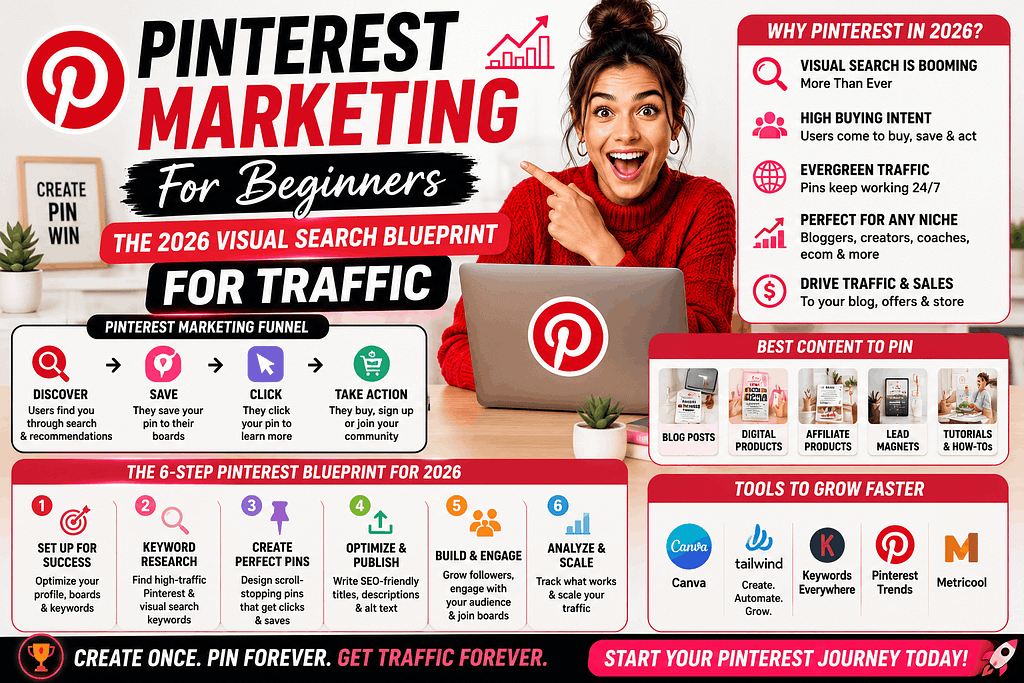
But as we navigate through 2026, the digital landscape has shifted dramatically. With Google’s search ecosystem evolving and traditional social networks locking down their algorithms to trap users inside “walled gardens,” smart creators are pivoting. They’ve realized a massive truth: Pinterest is not a social media platform. It is a visual search engine.
When an American shopper sits on their couch in Charlotte or Austin and opens Pinterest, they aren’t looking to see what their high school friends are up to. They are typing highly specific queries into a search bar because they want inspiration, a solution, or a product to buy.
If you know how to talk to that visual search bar, you can tap into a goldmine of high-intent, US-based traffic. Whether you are selling digital products on Earnify05, driving readers to an AI blog, or launching an e-commerce storefront, this Pinterest marketing for beginners guide is your definitive, 1,000-word blueprint to explosive organic growth.
1. The 2026 Shift: Decoding the Visual Search Algorithm
Pinterest’s algorithm doesn’t read a pin the way a human does, nor does it scan it exactly like a traditional text-based search crawler. Today, the platform uses an incredibly advanced multi-modal framework that balances three distinct pillars to rank content:
-
Textual Metadata: Your pin titles, descriptions, board names, and profile bio keywords.
-
Visual Graphing (AI Computer Vision): The algorithm literally “scans” the pixels, detecting objects, color schemes, and—most importantly—the text written on your image to categorize it.
-
Engagement Density: Clicks, close-ups, and saves (re-pins) within the first few hours of a pin going live.
If you want your content to surface when a user searches for a solution, all three of these pillars must point to the exact same concept.
2. Step 1: The Native Keyword Research Hack
Stop buying expensive third-party keyword tools. The absolute best search data comes directly from the source. Pinterest wants you to find what’s trending, so they leave the data out in the open.
The Predictive Search Bar Method
Go to the Pinterest search bar and type in your broad niche—for example, “Side Hustles.” Do not press enter. Look closely at the drop-down menu that automatically populates below. Pinterest is showing you the exact, real-time long-tail phrases that users are typing right now. You might see:
-
Side hustles for beginners 2026
-
Side hustles from home for moms
-
Side hustles with AI tools
These are your exact target coordinates. Copy them down. These exact natural-language phrases are what you will use to build your account framework and pin descriptions.
3. Step 2: Architecting a High-Authority Profile
You cannot rank a single pin if your overall profile looks like a chaotic collection of personal hobbies. To the algorithm, your account needs to scream “Niche Authority.”
-
The Power Title: Don’t just list your name or brand name. Add your primary focus keyword right next to it. For example: Your Name | Pinterest Marketing for Beginners & SEO Tips.
-
The Bio Keyword Injection: You have 160 characters. Use them to state exactly what problem you solve, weaving in secondary keywords naturally. “Helping digital creators master Pinterest marketing for beginners to drive massive organic web traffic to Earnify05 using free optimization strategies.”
-
Board Synchronization: When you create a board, give it a clear, search-friendly name. Avoid abstract titles like “Wealth Vibes ✨.” Use “Passive Income Strategies” or “Digital Marketing for Beginners.” Write a 2-3 sentence description for every single board, packed with your researched keywords.
4. Step 3: Designing the Perfect “Visual Hook”
Because Pinterest is an entirely visual feed, your technical optimization means absolutely nothing if nobody stops to look at your graphic. The home feed moves incredibly fast on mobile devices, meaning your image has to act like a physical speed bump.
The Anatomy of a High-Click Pin:
-
The 2:3 Aspect Ratio: This is a non-negotiable metric. Use a standard canvas of 1000 x 1500 pixels. Square or overly long images get penalized by the smart feed’s layout engine.
-
High-Contrast Text Overlay: Put your core benefit or “Hook” directly on the image using bold, clean typography. Avoid delicate, sweeping script fonts. The AI computer vision scanner needs to read your image text instantly.
-
Visual Proof or Progression: Show a snippet of a checklist, a chart, or a stunning visual mock-up of what the user gets when they click.
5. Step 4: Formatting Your Pins for Maximum Reach
When you hit the “Create Pin” button, you are filling out a data index sheet for the search engine. Do not rush this process.
-
The Title: Place your target focus keyword at the very beginning. Keep it punchy and clear. Example: Pinterest Marketing for Beginners: The 3-Step Traffic Blueprint.
-
The Description: Write a helpful, human paragraph that naturally incorporates 3 to 4 secondary long-tail keywords. Avoid robotic keyword stuffing. Example: “Struggling to get eyes on your new website or store? This guide on Pinterest marketing for beginners breaks down how to set up your profile, research low-competition visual keywords, and scale your organic traffic curve fast.”
-
The Destination Link: Ensure your link goes directly to the exact piece of content promised on the pin graphic. If your pin promises a “Free Prompt Pack,” do not link to your general homepage. Pinterest actively tracks bounce rates; if users click your pin and instantly leave your site because they feel misled, your account’s distribution will tank.
6. Bypassing the Quality Filters: The “Human Signature”
Pinterest has become ruthlessly strict about automated, low-value spam. If you use external bots to randomly scrape images and blast 50 stolen graphics a day into the ecosystem, your account will be shadowed or banned within a week. To build a highly profitable asset on Earnify05, you must apply the 10% Human Layer:
-
Freshness Over Repetition: Pinterest heavily prioritizes Fresh Pins (meaning a totally new graphic, even if it points to an older web link). Stop pinning the exact same image to ten different boards.
-
Burst Pacing & Rhythm: When writing your descriptions, break the robotic, uniform patterns that text generators love. Use short, sharp realizations. Then cascade into a longer, descriptive thought.
-
Real US Context: Tailor your hooks around the exact cultural and seasonal mindsets of your US audience. Mentioning specific constraints—like optimizing a workflow around a chaotic Monday morning commute on I-40, or preparing a budget for the upcoming US tax season—gives your pins a lived-in authenticity that automated systems cannot replicate.
Are you going to build your first optimized Pinterest board around Side Hustles, Creative Design, or Tech Tutorials? Let’s map out your visual keyword seed list down in the comments below!