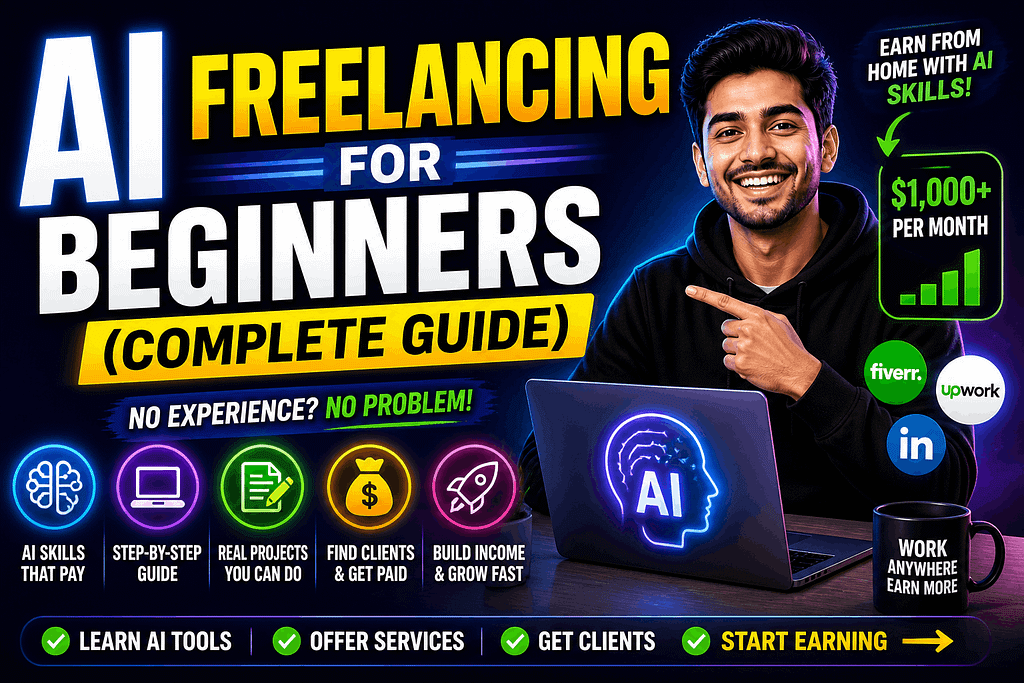
Let’s be honest: the traditional freelance market is crowded. If you go onto platforms like Upwork or Fiverr today as a “generic” writer or graphic designer, you are competing against millions of people for projects that pay pennies. But in 2026, a massive “Blue Ocean” has emerged. It’s called AI Freelancing.
I’m not talking about letting a bot do your job. I’m talking about becoming an AI Orchestrator. As we move through this year, US-based small businesses—from real estate firms in Raleigh to tech startups in Austin—are starving for efficiency. They don’t want to learn how to use Claude 4 or Midjourney; they want the result that those tools provide.
If you have a laptop and a bit of curiosity, you can bridge that gap. This is your 1,000-word, no-nonsense roadmap to starting an AI Freelancing career from scratch with zero investment.
1. The Mindset Shift: Selling Outcomes, Not Hours
The biggest mistake beginners make is trying to sell “AI Services.” No business owner in North Carolina wants to buy “a ChatGPT prompt.” They want to buy a solution.
-
The Old Way: “I will write a 1,000-word blog post for $50.” (Takes 4 hours).
-
The AI Way: “I will deliver 5 SEO-optimized, human-polished articles and 10 social media posts for $300.” (Takes 1 hour with the right AI workflow).
Your value as an AI freelancer is your ability to deliver high-volume, high-quality work in a fraction of the time. You aren’t getting paid for your “labor”; you are getting paid for your logic and your system.
2. The Top 3 AI Freelancing Niches for 2026
To hit that first $1,000 month, you need to pick a lane. Here are the three most beginner-friendly niches currently exploding in the USA.
Path A: The Short-Form Content Alchemist
Every brand in America knows they need to be on TikTok, Reels, and Shorts, but almost none of them have the patience to edit vertical video.
-
The Service: Repurposing long-form podcasts or YouTube videos into 60-second viral clips.
-
The Workflow: Use tools like OpusClip Pro or InVideo AI. They find the “hooks,” add the captions, and crop the frame. You provide the final 10% “Human Polish.”
-
The Payout: A $500 monthly retainer for 10 clips is a standard, easy “yes” for most creators.
Path B: The Professional “Vocal” Architect
The US corporate and real estate markets are starving for high-quality audio, but recording a professional voiceover traditionally required a $2,000 studio setup.
-
The Service: “Studio-Grade” narrations for e-learning, real estate tours, or audiobooks.
-
The Workflow: Use ElevenLabs’ “Speech-to-Speech” feature. Record yourself on your phone (capturing your human emotion and natural pauses) and “mask” it with a professional AI voice. Run it through Adobe Podcast (Enhance) to remove all background noise.
-
The Payout: A professional 10-minute narration can net you $100 – $200 for roughly 30 minutes of work.
Path C: The Visual Identity Designer
Small businesses need consistent social media visuals but can’t afford a $60,000-a-year graphic designer.
-
The Service: Creating “Brand Kits” and custom AI-generated social media content packs.
-
The Workflow: Use Canva Magic Studio combined with Midjourney v6. You generate unique, high-fidelity images that fit the brand’s vibe and turn them into editable templates.
-
The Payout: Selling a “Content Pack” of 30 pins/posts can easily net you $300 per client.
3. The Freelancing 4-Step Blueprint to Your First Client
Step 1: The “Ghost” Portfolio
Nobody hires a “beginner.” They hire a “result.” Before you send a single email, create three high-quality samples.
-
Action: Pick a real local business in your town. Don’t ask permission. Create a 30-second “Viral Reel” for them or a redesigned homepage mock-up. This is your “Proof of Concept.”
Step 2: The “Local-First” Outreach
Stop fighting for $5 on global platforms. Go to LinkedIn and search for business owners in your specific state. People in the US still value “local” connections.
“Hey [Name], I’m a local content strategist in [City]. I saw your last video and took the liberty of turning it into two high-retention Reels to show you what’s possible with my new AI workflow. Check them out attached. If you like the style, I’d love to handle your weekly content for a flat monthly fee.”
Step 3: The “Service-First” Close
When you pitch, offer a “First-Timer Bundle.” Instead of a complex contract, offer a “One-Week Sprint” for $150. It lowers the risk for the client and allows you to prove your value instantly.
Step 4: The Retainer Pivot
One-off jobs are exhausting. Once a client pays you for a sprint, pivot them to a monthly subscription. “Instead of $150 for this one-off, I can handle your entire content presence for $500 a month.” Land just two of these, and you have a rock-solid side income.
4. How to Bypass AI Detectors (The “Human Signature”) Freelancing
Search engines and clients in 2026 are smart; they can sense “lazy AI slop.” To ensure your work ranks and stays profitable, you must apply the “10% Human Rule.”
-
Fact-Check Everything: AI hallucinates. Never send a project to a client without verifying names, dates, and local US facts.
-
Add Subjective Flavor: AI provides data; humans provide opinion. Add a personal anecdote, a local reference (e.g., “Much like the humidity in Raleigh, your competition is inescapable”), or a specific industry insight.
-
Vary the Pacing: AI loves “average” sentence lengths. To make your work feel human, mix short, punchy realizations with longer, descriptive thoughts.
5. Scaling to a Full-Time AI Agency Freelancing
The goal of AI freelancing for beginners is to move from Labor to Logic. Once you have three clients paying you $500/month, you are making $1,500/month for roughly 10 hours of work a week.
At this stage, you don’t work more; you simply add more “Agents.” You hire a virtual assistant or set up a complex automation via Make.com to handle the repetitive parts of the business, like invoicing and lead generation. This is how you move from a “freelancer” to a “business owner.”
Which of these three paths—Video, Voice, or Design—are you going to master this weekend? Let’s build your “Day 1” strategy in the comments!