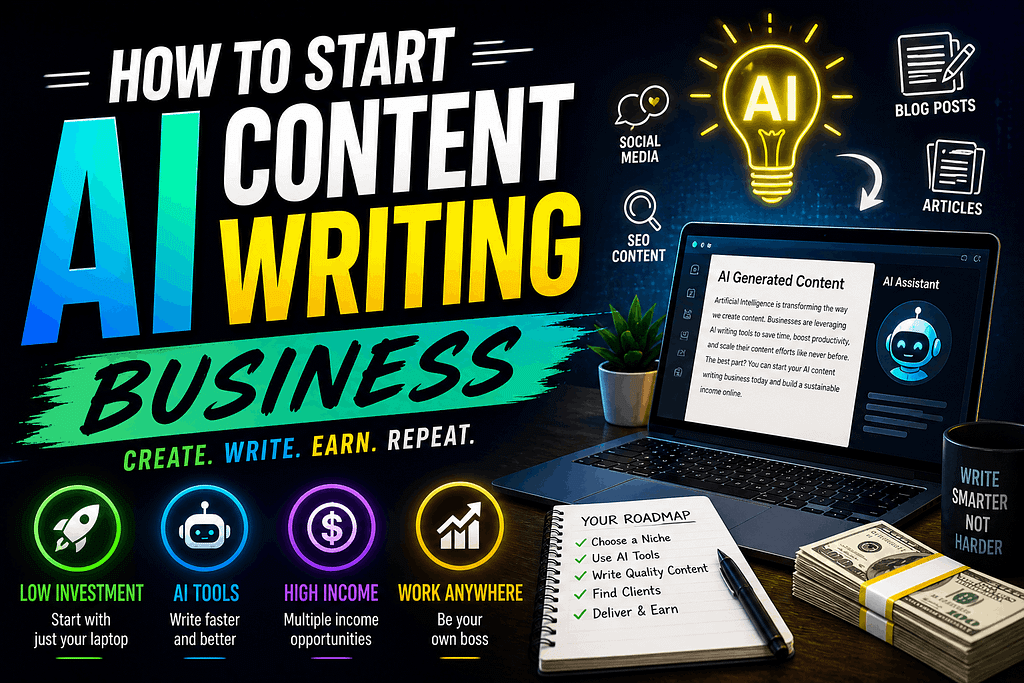
Let’s be honest: the “content writing” world as we knew it two years ago is dead. If you’re trying to start a business today by selling $20 blog posts that look like they were spit out by a generic bot, you’re racing toward a zero-dollar bank account. In 2026, the market is flooded with “AI slop,” and US-based businesses are starving for something different.
The real opportunity isn’t in “AI writing”—it’s in AI-Augmented Editorial Strategy.
Whether you’re based in a tech hub like Raleigh or working remotely from a kitchen table in the Midwest, starting a content business now requires a shift from being a “typist” to becoming a System Architect. You are no longer selling words; you are selling outcomes. Here is your 1,000-word, human-centric roadmap to launching a high-margin AI content writing business from scratch.
1. The 2026 Reality: Why “Human-in-the-Loop” is Your Unique Selling Point
Small and medium-sized businesses (SMBs) in the USA are currently overwhelmed. They know they need to rank on Google’s Search Generative Experience (SGE), and they know they need a voice on LinkedIn, but they’ve been burned by low-quality AI content that feels hollow and risks search engine penalties.
Your business model shouldn’t be: “I use AI to write for you.” Your model must be: “I use advanced AI workflows to scale your brand’s unique human authority.”
By positioning yourself as the “Human-in-the-Loop,” you bridge the gap between machine efficiency and human empathy. You are the one who ensures the facts are right, the “vibe” is local, and the strategy actually converts readers into customers.
2. The Tech Stack: Building Your “Ghost” Editorial Team
To hit a consistent income goal, you cannot rely on a single prompt. You need an “Orchestration Stack.” In 2026, these are the essential tools for a high-performance content business:
-
Claude 4 & Perplexity AI: Use Perplexity for hyper-accurate, real-time research (crucial for US-based compliance and local news) and Claude for its superior empathetic, “literary” tone that bypasses standard AI detectors.
-
SurferSEO or Rank Math: To ensure every piece of content is mathematically optimized for the latest search algorithms.
-
Make.com or Zapier: To automate the “boring” parts—like moving a drafted article from Claude to a WordPress staging site or a client’s Slack channel.
3. The 3-Step Launch Blueprint
Step 1: Define Your “Authority” Niche
Do not be a generalist. A “Generalist AI Writer” is a commodity. An “AI Content Strategist for Raleigh Real Estate” or a “Technical Content Partner for B2B SaaS” is a specialist. In the US, specialists charge 3x more. Pick a niche where you already have some “human” knowledge so you can fact-check the AI with ease.
Step 2: Build a “Ghost” Portfolio
Nobody will hire you based on a resume. They hire based on a result.
-
Action: Pick three major problems in your niche. Use your AI workflow to solve them.
-
Example: If you’re targeting local HVAC companies, write a deep-dive guide on “How North Carolina Homeowners Can Save 30% on Cooling with Smart Tech.” This proves you can handle local context and technical detail.
Step 3: The “Local-First” Outreach
Stop fighting for $5 on global freelance platforms. Use LinkedIn to find marketing managers in your specific state.
“Hey [Name], I noticed your blog hasn’t been updated since the latest Google Search update. I’ve developed a human-led AI workflow that produces 100% accurate, high-authority content specifically for the [Niche] market. I’d love to send over a sample tailored to your brand’s voice.”
4. How to Bypass Ai Detectors (The “Human Signature”)
Google doesn’t hate AI; it hates low-value content. To ensure your business thrives and your clients keep coming back, you must apply the “10% Human Signature” to every deliverable:
-
The Fact-Check: AI hallucinates. Never send a project without verifying names, dates, and US-specific laws. This is where you earn your fee.
-
The “Subjective” Layer: Ai is great at facts but terrible at “opinions.” Manually add a personal anecdote, a local reference (e.g., “Much like a Saturday afternoon at the Durham Farmers’ Market, your customer’s options are plentiful but overwhelming”), or a specific industry insight.
-
Vary the Pacing: AI loves “average” sentence lengths. To make work feel human, mix short, punchy realizations with longer, descriptive thoughts.
5. Pricing for Profit: Moving Beyond “Per Word”
In 2026, charging “per word” is a trap. If you use AI to write 1,000 words in 10 minutes, you are punishing yourself for being efficient. Instead, use Outcome-Based Pricing:
-
The “Authority” Package ($1,500/mo): 4 long-form articles, 12 LinkedIn posts, and 1 monthly SEO report.
-
The “Sprint” Package ($500): A full website copy rewrite (Home, About, Services) delivered in 48 hours.
Because you are using AI as your “unpaid intern,” your actual labor on these packages might only be 5–8 hours a month, but the value to the business is immense.
6. Scaling to a “Solo Empire”
To reach the $5,000/month milestone, you have to stop being the one doing the prompts.
-
Build Your SOPs (Standard Operating Procedures): Document exactly how you use Claude and Perplexity to get the “perfect” draft.
-
Hire a “Human” Editor: Once you have 5+ clients, hire a junior editor to do the final fact-check and “humanizing” polish.
-
Automate Lead Gen: Use AI tools to find new businesses that are “under-performing” in SEO and automatically send them your portfolio.
Which niche are you going to dominate—Real Estate, Tech, or Local Healthcare? Let’s talk about your “Authority” samples in the comments!