Starting a side hustle sounds exciting until you start thinking about the money required to get started.
Do you need an expensive website? A large inventory? Professional equipment? Paid advertising?
Not necessarily.
In 2026, there are plenty of ways to start earning extra income without putting hundreds or thousands of dollars on the line. In fact, some of the best opportunities are built around skills, services, and tools you already have.
For beginners in the United States, keeping the initial investment below $100 can be a smart way to test an idea before committing serious money.
The key is to start small, learn what customers actually want, and reinvest your first earnings instead of spending everything upfront.
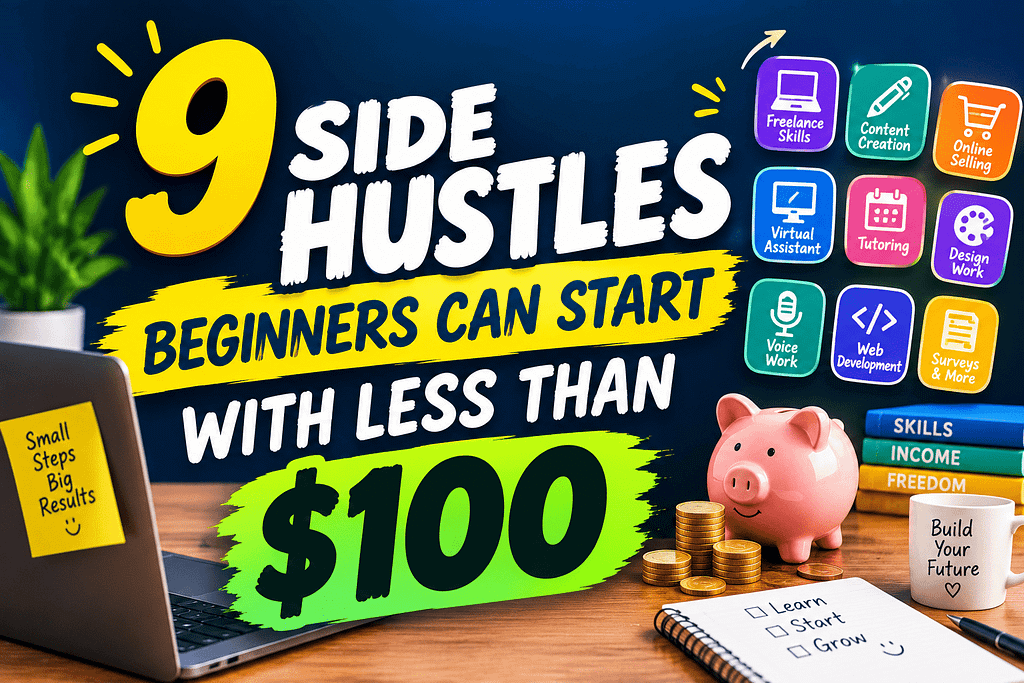
Here are 9 side hustles beginners can start with less than $100.
1. Freelance Writing
If you’re comfortable writing emails, articles, product descriptions, social media captions, or website content, freelance writing can be an inexpensive side hustle to start.
You don’t need an office or expensive equipment. A computer, internet connection, and a few strong writing samples can be enough to begin looking for clients.
Beginners can create sample articles around topics they understand and use those samples as a basic portfolio.
Instead of trying to become a full-time writer immediately, start by targeting small assignments. Once you have satisfied clients and positive reviews, you can gradually increase your rates.
Startup cost: $0–$50
Good for: Students, employees, bloggers, and strong communicators.
2. Virtual Assistant Services
Small businesses often have plenty of work but not enough time to handle every administrative task.
That’s where virtual assistants come in.
You could help with scheduling, email organization, online research, spreadsheet updates, customer follow-ups, data entry, or social media management.
One advantage of this side hustle is that you don’t necessarily need advanced technical skills. Being organized, dependable, and comfortable with common online tools can take you a long way.
Start by choosing two or three services rather than offering everything.
Startup cost: $0–$50
Good for: Organized people, remote workers, and beginners looking for recurring clients.
3. Sell Digital Products
Digital products can be attractive because you create them once and can potentially sell them repeatedly.
Examples include budget spreadsheets, planners, checklists, resume templates, study materials, presentation templates, or printable organizers.
For example, someone interested in personal finance could create a simple monthly budgeting spreadsheet designed for people trying to manage their household expenses.
The important part is solving a specific problem. A generic product may struggle to attract attention, while a useful product aimed at a particular audience has a clearer purpose.
Startup cost: $0–$50
Good for: Creative people, designers, students, and people with useful knowledge to package.
4. Pet Sitting or Dog Walking
Not every profitable side hustle needs to happen online.
Pet care can be a straightforward local opportunity, particularly for people who enjoy working with animals.
Dog walking, pet sitting, and house visits can fit around a full-time job if you carefully choose your availability.
Your initial spending might go toward basic supplies, transportation, business cards, or local advertising.
The real advantage is trust. If you provide reliable service, happy customers may recommend you to friends, neighbors, and coworkers.
Startup cost: $20–$75
Good for: Animal lovers and people looking for a flexible local side hustle.
5. Reselling Items Online
Reselling can be started with very little money if you begin by selling things you already own.
Look around your home for clothing, electronics, books, collectibles, furniture, or other items you no longer use.
Once you understand what sells, you can use a small portion of your profits to purchase undervalued items and resell them.
The biggest lesson here is not to buy a large amount of inventory before you understand your market.
Research completed sales, calculate fees and shipping costs, and make sure there’s enough potential profit before buying anything.
Startup cost: $0–$100
Good for: Bargain hunters and people interested in online marketplaces.
6. Social Media Management
Many local businesses understand that social media matters but don’t have the time to post consistently.
A beginner can offer simple social media services such as creating posts, writing captions, scheduling content, or responding to basic comments.
You don’t need to start with major brands. Local restaurants, salons, fitness businesses, real estate professionals, and small retailers may be easier targets.
Create a few sample posts for your portfolio and contact businesses with a simple, personalized offer.
Startup cost: $0–$75
Good for: Social media users, creative people, and marketing beginners.
7. Tutoring
If you’re particularly good at a subject, tutoring can turn existing knowledge into extra income.
You could tutor students in mathematics, science, English, computer skills, or other subjects you’re confident teaching.
Online tutoring gives you access to a broader audience, while local tutoring can work well if you prefer face-to-face sessions.
You don’t need to spend hundreds of dollars creating a complicated business. A reliable computer, internet connection, and a professional way to communicate with students may be enough to begin.
Startup cost: $0–$50
Good for: Students, graduates, teachers, and subject-matter experts.
8. Print-on-Demand
Print-on-demand allows you to sell designs on products such as T-shirts, mugs, tote bags, posters, and other merchandise without buying inventory upfront.
When a customer places an order, the product is produced and shipped through the service provider.
This makes the business model less risky than purchasing boxes of inventory before you know whether anyone wants your designs.
However, competition is significant. Instead of uploading random designs, focus on a specific audience or interest.
For example, designs aimed at a particular hobby, profession, community, or lifestyle can give your store a clearer identity.
Startup cost: $0–$100
Good for: Designers, artists, and people interested in e-commerce.
9. AI-Assisted Freelance Services
AI has created another opportunity for beginners: offering services that use AI to complete routine work more efficiently.
You could offer services such as basic content creation, research assistance, presentation preparation, spreadsheet organization, social media content planning, or resume formatting.
The important distinction is that you’re selling the finished service, not simply selling access to an AI chatbot.
Clients still need someone who understands their goals, checks the output, fixes mistakes, and delivers useful work.
Learning how to combine AI with human judgment can therefore become a valuable skill.
Startup cost: $0–$100
Good for: Tech-savvy beginners, freelancers, students, and professionals.
How to Choose the Right Side Hustle
With so many options available, choosing one can actually be harder than starting one.
A simple way to narrow the list is to consider three things:
Your skills: What can you already do reasonably well?
Your available time: Can you work two hours on weekends, or do you have an hour every evening?
Your budget: How much money can you comfortably afford to lose while testing the idea?
For example, someone with strong writing skills might start freelancing, while someone who enjoys animals could choose pet sitting. A creative person might prefer digital products or print-on-demand.
Don’t choose a side hustle simply because someone online claims it is easy money.
Start Small and Validate the Idea
One of the biggest advantages of choosing side hustles beginners can start for under $100 is that your financial risk can remain relatively low.
You don’t need a perfect logo, expensive office, complicated website, or huge inventory on day one.
Your first goal should be finding out whether people will actually pay for what you’re offering.
Try to get your first customer before making major investments.
Once you earn money, reinvest a portion into better tools, marketing, education, or equipment.
This approach gives you something more valuable than a large initial budget: real feedback from customers.