Let’s be brutally honest for a moment: the digital search landscape has fundamentally fractured. If you are sitting in a home office in Raleigh, running a boutique agency in Austin, or managing your digital portfolio layout on Earnify05, you already know the sinking feeling of looking at traditional web analytics. Content that would have easily captured the number-one spot two years ago is suddenly sliding down the page.
As we navigate through 2026, Google’s AI Overviews and conversational answer engines like Perplexity have caused organic click-through rates (CTR) on simple, informational searches to drop significantly. Because search engines now summarize answers directly on the results page, the old method of writing endless, superficial fluff pieces to capture single keywords is officially dead.
But here is the silver lining: you do not need a multi-million dollar marketing budget or an advanced data science degree to fix your plummeting metrics. You just need to look beyond the mainstream marketing echo chamber.
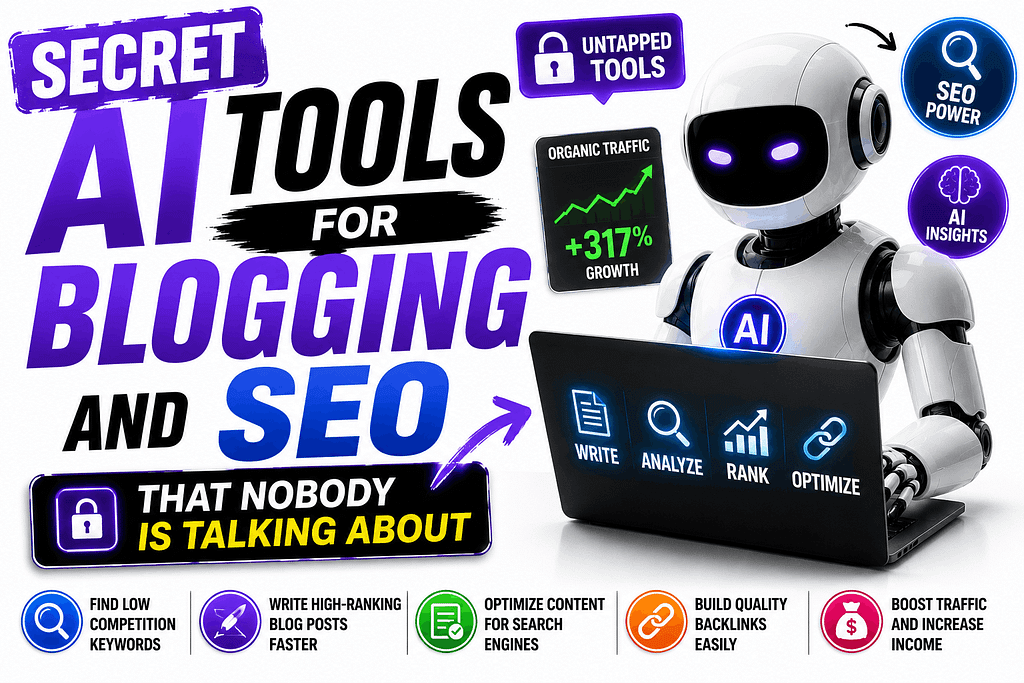
Discover five underground, highly effective, secret AI tools for blogging and SEO that your competitors do not know exist. These platforms will help you bypass robotic patterns, align perfectly with modern search intent, and create authentic, value-driven content that connects with readers and search engines alike.
1. AirOps: Scaling Programmatic SEO and Contextual Workflows
When most creators think of automated writing, they picture a single window where they paste a prompt and wait for a generic article. AirOps completely flips this concept on its head by allowing bloggers to build custom, multi-step AI execution workflows.
Instead of generating flat text, AirOps integrates directly with live data sources, allowing you to build deeply customized content templates. For example, if you run a real estate blog or a technical data site, you can pull raw statistics, stream them through a specialized AirOps workflow, and instantly create highly detailed, accurate long-form pages. It bridges the gap between deep data analytics and natural language generation, making it an essential asset for advanced programmatic SEO.
2. Quattr: Mastering Semantic Keyword Clustering
Traditional keyword research tools often give you a flat list of phrases sorted by raw volume. However, search engines no longer just look for exact-match terms; they reward comprehensive topical authority. Quattr utilizes advanced machine learning to provide advanced semantic keyword clustering.
As shown in the semantic roadmap above, modern visibility requires a shift away from single keywords toward full topical networks. Quattr automates this entire cycle:
-
Intent Mapping: It groups keywords based on underlying conceptual relationships and actual user intent rather than simple spelling similarities.
-
Automated Elements: It features highly precise generators for target H1 headers, clear meta descriptions, and clean URLs that search bots can seamlessly index.
-
Gap Identification: By analyzing exactly why top-performing sites hold their positions, it highlights the precise subtopics your article needs to cover to remain competitive.
Using a semantic tool ensures your content addresses the entire scope of a topic. This structure makes your articles highly eligible for AI search summaries and premium search rankings.
3. Outranking: Data-Driven Content Briefs and Blueprinting
Most writers know about popular optimization tools that score a draft while you type. However, the real work happens before you write the very first sentence. Outranking acts as an advanced architectural planning assistant for your blog posts.
It deeply analyzes the top ten results on search engines and builds a comprehensive structural blueprint. Outranking extracts the exact questions target audiences ask across forums and maps out precise natural language processing (NLP) terms. By aligning your headings and content structure with proven user intent before writing, you drastically reduce editing time and ensure your articles are inherently optimized from the ground up.
4. Wellows: Maximizing Search Visibility and Citation Growth
Search has evolved significantly. Discoverability is no longer just about standard links; it is about becoming a trusted source that search engines actively reference. Wellows focuses on maximizing search visibility scores and expanding your citation footprint.
The platform tracks how search algorithms interpret, categorize, and utilize your published text. It gives you clear, actionable insights on how to format your data, list key definitions, and structure insights so algorithms can easily pull your site as a primary source. Getting cited as a foundational reference is one of the fastest ways to drive consistent, high-tier organic traffic to your platform.
5. RightBlogger: The Ultimate Dedicated Content Creator Toolbox
While major multi-purpose AI platforms try to handle everything from software engineering to customer support, RightBlogger is built entirely by content creators, specifically for content creators. It features a streamlined suite of over 80 tailored tools designed to handle every step of the creative workflow.
From generating engaging article introductions to crafting structured content outlines and unique social media hooks, it removes the friction from managing a high-volume publication. It balances data-driven optimization with a clean, writer-focused interface, allowing independent publishers to scale production without losing technical accuracy.
The Formula for Human-Centric, Search-Optimized Content
Discovering unique software tools is only half the battle. To rank highly in competitive regions like the United States, your content must sound completely natural, deeply authoritative, and distinctly human.
At Earnify05, our publishing philosophy relies on a clear, systematic approach to ensure every article satisfies both complex algorithmic requirements and human readers:
Step 1: Deploy the 40-Word “Direct Answer Block”
In 2026, search engines operate as answer engines. If an AI crawler indexes your article and has to sift through three paragraphs of conversational introductory text just to find a simple definition, it will ignore your page when compiling its top-of-page AI Overview card. Give the machine the punchline first to increase your likelihood of being cited as an authoritative source card.
Step 2: Injecting Unique Points of View (POV)
Generic text repeats widely available online summaries. To stand out, inject original perspectives, real-world examples, and data insights that standard articles overlook. Speak directly to the reader like a knowledgeable peer. Algorithms can compile statistics, but they cannot have an opinion, a business failure, or a personal breakthrough.
Step 3: Eliminating Mechanical Language Patterning
Automated text writing software frequently relies on predictable, repetitive structural patterns. To ensure your text reads naturally, vary sentence lengths intentionally, use clean transitions, and avoid overly verbose corporate phrases.
| Instead of Writing… | Use Natural Alternatives Like… |
| “It is important to remember that…” | “Keep in mind…” |
| “In order to achieve optimal success…” | “To get the best results…” |
| “Furthermore, utilizing this methodology…” | “Plus, using this method…” |
Key Strategy for 2026: Modern search ranking values original perspectives and substantive depth. Don’t simply rewrite what the top results say. Use advanced software tools to handle data organization, keyword clustering, and technical frameworks, then focus your creative energy on adding real human insight and practical value.
By building a balanced workflow that pairs underground data tools with clear, engaging language, you can consistently grow your site’s audience and build a sustainable digital asset.