Let’s be real: being a student in 2026 is expensive. Whether you’re navigating a campus in Raleigh or studying remotely from a coffee shop in Austin, the cost of living—and that inevitable student loan cloud—is a constant weight. In the “old days,” a student job meant folding t-shirts at the mall or flipping burgers until 2:00 AM. While there’s nothing wrong with honest labor, it’s not exactly efficient when you have a 10-page research paper due on Monday.
The game has changed. We are now in the era of AI Orchestration. For a student, AI isn’t just a tool to help summarize notes; it’s a high-leverage “unpaid intern” that allows you to start a business between classes. You don’t need a $5,000 startup fund or a computer science degree. You just need a laptop, a bit of curiosity, and the right workflow.
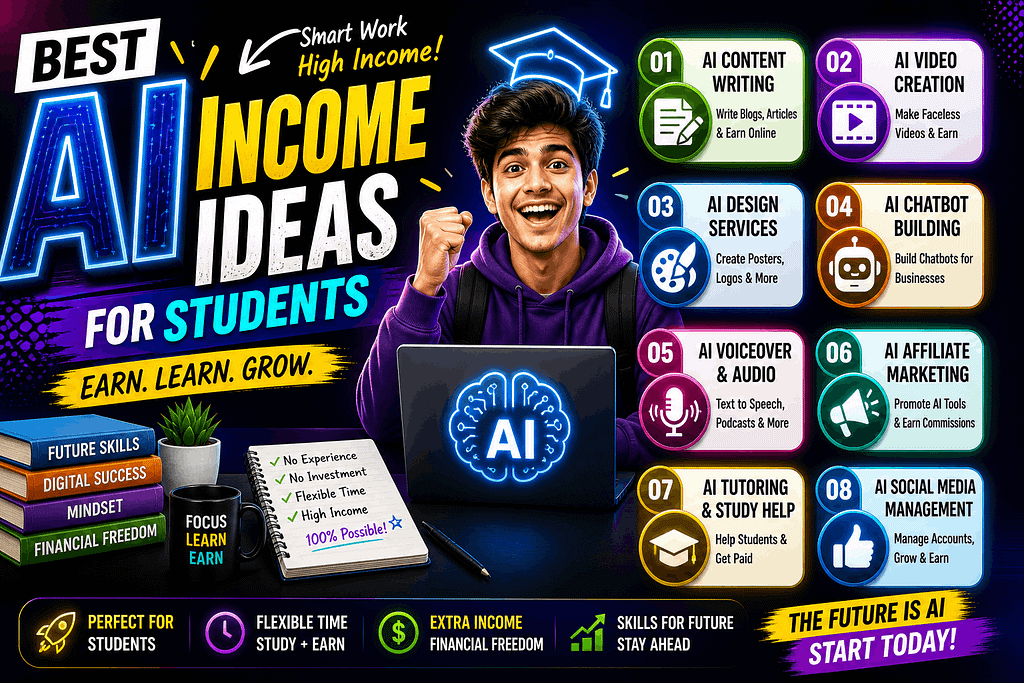
Here is your 1,000-word, human-centric blueprint for the best AI income ideas for students that actually pay off in the real world.
1. The Mindset: Stop Trading Hours for Dollars AI Income Ideas
The biggest mistake students make is looking for “AI tasks.” You shouldn’t be looking for a job where you get paid $15 an hour to enter data. Instead, you should be an Architect of Outcomes.
Small businesses in the US are currently drowning in technical debt. A local real estate agent or a boutique owner knows they need to use AI to stay competitive, but they are too busy running their business to learn the difference between a “prompt” and a “parameter.” As a student, you have the digital fluency they lack. Your income comes from bridging that gap—providing the professional result they are willing to pay a premium for.
2. Path #1: The “Vocal Engineer” (High-Margin Freelancing)
One of the most overlooked opportunities in 2026 is the demand for high-quality audio in corporate training and real estate. Traditionally, a professional voiceover required a $2,000 studio setup. Today, it requires a phone and a few smart AI layers.
The Workflow:
-
Scripting: Use Claude 4 to refine a technical script into something that sounds natural and conversational.
-
The Vocal Mask: Use ElevenLabs’ “Speech-to-Speech” feature. Record yourself reading the script on your phone—this captures your human emotion, natural pauses, and cadence. Then, have the AI “mask” your voice with a high-authority, professional tone.
-
The Studio Polish: Run that audio through Adobe Podcast (Enhance) to remove background noise, making a kitchen-table recording sound like a New York City studio.
The Income Potential:
List your services for “Corporate Narration” or “Audio Property Tours” on LinkedIn. A professional 10-minute narration can net you $100–$200 for roughly 30 minutes of actual work.
3. Path #2: The “Short-Form” Content Alchemist
In 2026, attention is the most valuable currency in America. Every brand—from your local dentist to the biggest campus influencers—needs to be on TikTok, Reels, and Shorts. However, almost none of them have the patience to edit vertical video.
The Workflow:
-
Identify the Source: Find high-value long-form podcasts or webinars on YouTube.
-
The Extraction: Use tools like OpusClip or InVideo AI to automatically find the “hooks” and crop them into 9:16 vertical frames with captions.
-
The Human Signature: Spend 10 minutes fixing grammar and adding the brand’s specific colors to ensure it doesn’t look like “AI slop”.
The Income Potential:
Reach out to local businesses or YouTubers. Offer a “Short-Form Content Package” for a monthly retainer. Landing just two or three clients for $500 a month each creates a predictable income for a few hours of work a week.
4. Path #3: The “Visual Identity” Architect
Small businesses are desperate for high-end visuals but can’t afford $5,000 agency fees. You can fill this gap by creating “Brand Kits” and custom AI-generated social media content packs.
The Workflow:
-
The Niche Hunt: Look for local businesses on Instagram whose graphics look outdated or inconsistent.
-
The AI Design: Use Canva Magic Studio or Leonardo.ai to generate unique, high-fidelity images that fit the brand’s vibe.
-
The “Vision Pack”: Create a set of 10-15 templates (quotes, testimonials, and product shots) that the business can easily reuse.
The Income Potential:
A basic brand kit or social media “aesthetic overhaul” can easily net you $250–$400 per client.
5. Bypassing the AI Detector: The “Human Signature”
In 2026, the internet is flooded with “lazy” AI content. To ensure you get paid and your clients keep coming back, you must apply a Human Signature to everything you produce.
-
Fact-Checking: AI hallucinates. Never send a project to a client without verifying names, dates, and local US facts.
-
Subjective Flavor: AI provides data; humans provide opinion. Add a personal anecdote, a joke, or a local reference that a bot couldn’t know.
-
Vary the Pacing: AI loves “average” sentence lengths. Mix short, punchy realizations with longer, descriptive thoughts to make the work feel “lived-in” and authentic.
6. How to Scale to a “Solo Empire” While in Class
To hit a consistent income goal, you have to move away from “one-off” jobs and toward Retainers and Digital Assets.
-
Build a “Ghost” Portfolio: Create 5-10 high-quality samples in a specific niche (e.g., Real Estate or Tech) to show potential clients what you can do.
-
The “Local-First” Outreach: Don’t fight for $5 on global platforms. Use LinkedIn to find business owners in your specific city or state.
-
Automate the Boring Parts: Once you land a client, use tools like Make.com or Zapier to automate the delivery process so you can focus on your exams while the “engine” runs in the background.
The “AI Gold Rush” of 2026 won’t last forever. Right now, there is a massive gap between what the technology can do and what the average US business owner understands. That gap is your Profit Zone.
You don’t need to be a genius; you just need to be proactive. While everyone else is worried about AI taking jobs, you can be the one using AI to build your own freedom. The $500/month goal is just the starting line. Once you realize you can fulfill a $100 project in 45 minutes, your “hourly rate” as a student becomes higher than most corporate executives.
Which of these three paths—Video, Voice, or Design—are you going to test out this weekend? Let’s talk about your “Day 1” strategy in the comments!