Some videos make people laugh.
Others teach something useful.
And then there are videos that make people feel something.
Those are the videos people remember, send to friends, comment on, and sometimes watch more than once.
If you’re a creator trying to grow on YouTube, TikTok, Instagram, or other short-form platforms, emotional storytelling can give your content a powerful human element.
However, there’s one thing to clarify: there is no guaranteed formula that makes a video go viral instantly. YouTube says recommendations are influenced by factors such as whether viewers choose to watch, how long they stay, and whether they enjoy the content.
So instead of chasing a guaranteed viral trick, focus on creating stories that people genuinely want to watch and share.
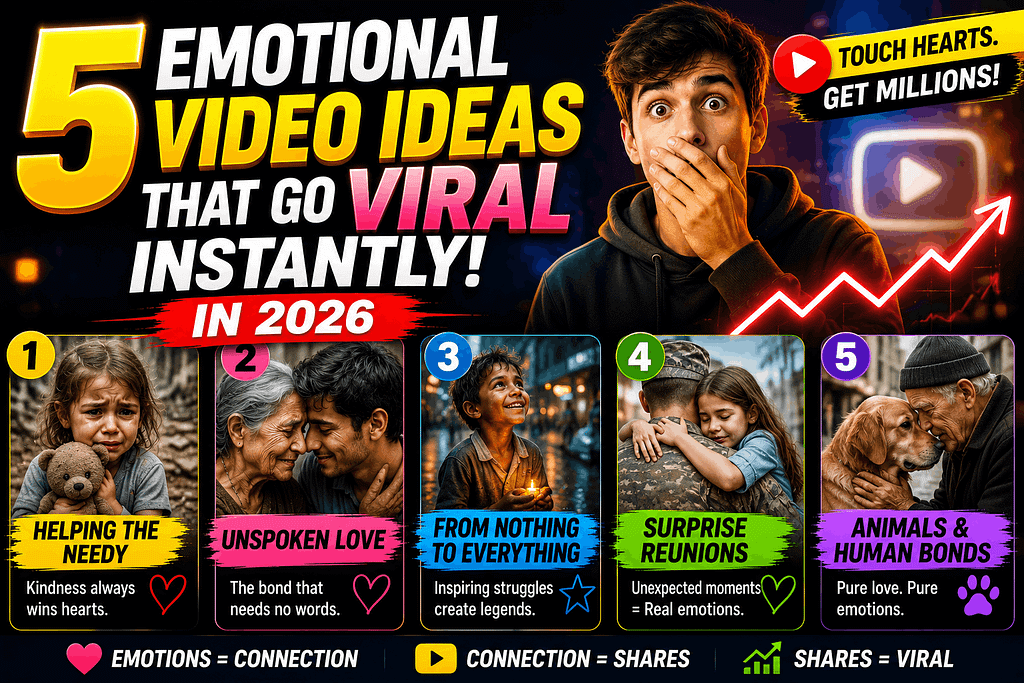
In this guide, Earnify05 explores five Emotional Video Ideas That Go Viral Instantly—or, more accurately, ideas designed to maximize emotional connection and viral potential.
Why Emotional Videos Get Attention
Think about the last video you shared with someone.
It probably wasn’t because the video had perfect SEO.
You shared it because it made you:
- Laugh
- Cry
- Feel inspired
- Remember someone
- Feel surprised
- Feel understood
- Want to help someone
- Think differently
Emotion creates a reason to continue watching.
For short-form content, the opening seconds are especially important. YouTube says creators should make the beginning immediately deliver on the promise made by the title or presentation, while audience retention can reveal where viewers lose interest.
That gives us an important formula:
Strong emotion + relatable story + compelling opening + satisfying ending = stronger viral potential
1. “I Almost Gave Up” Success Stories
Everyone loves a comeback.
A powerful video can begin with a person explaining a moment when they almost quit.
Maybe they:
- Failed their business
- Lost a job
- Failed an exam
- Struggled financially
- Had a project rejected
- Didn’t get the opportunity they wanted
- Spent months trying without seeing results
Then show what happened next.
Example Hook
“Six months ago, I was ready to give up. Then one unexpected message changed everything.”
That immediately creates curiosity.
The viewer wants to know:
What happened?
Don’t reveal the ending immediately.
Build the story.
Show the struggle, the turning point, and finally the lesson.
Why It Works
People naturally connect with stories about overcoming obstacles.
The important part is authenticity. Don’t invent a dramatic struggle simply because you think it will generate views.
Real stories are often more powerful because viewers can sense when something feels genuine.
2. Unexpected Acts of Kindness
Kindness videos can create a powerful emotional response because they give viewers something positive to remember.
For example:
A creator notices a struggling small-business owner and decides to help.
A stranger receives an unexpected gift.
A young professional helps an older person learn how to use technology.
A customer secretly pays for someone else’s meal.
The possibilities are endless.
Example Hook
“She thought she was just helping a customer. She had no idea what was about to happen.”
The key is to create curiosity without misleading the audience.
Make the Ending Meaningful
Don’t make the entire video about the surprise.
Show the person’s reaction and explain why the moment mattered.
That turns a simple event into a story.
3. “Before and After” Life Transformation Stories
Transformation content is naturally visual.
It gives viewers a clear contrast between two points in time.
For example:
Before: A person is struggling to organize their life.
After: They have developed a practical productivity system.
Or:
Before: A beginner is afraid to start freelancing.
After: They complete their first project.
Other transformation ideas include:
- Room makeovers
- Career transformations
- Fitness journeys
- Financial habit changes
- Business journeys
- Creative projects
- Learning a new skill
Example Hook
“This was my life 12 months ago. I barely recognize it now.”
Then tell the audience what changed.
Don’t focus only on the final result.
The struggle in the middle is often the most interesting part.
4. A Letter to My Younger Self
This format can be incredibly relatable.
Imagine someone speaking directly to their younger self.
For example:
“Dear 20-year-old me, I know you think you’re behind everyone else. You’re not.”
From there, discuss lessons learned about:
- Money
- Career
- Relationships
- Failure
- Confidence
- Education
- Entrepreneurship
- Personal growth
The beauty of this format is that the person isn’t necessarily talking only to their younger self.
They’re also speaking to everyone currently experiencing the same uncertainty.
Why It Can Work
People often see their own experiences in someone else’s story.
A viewer might think:
“I needed to hear this today.”
That’s the kind of emotional reaction that can lead to comments and shares.
YouTube also recommends creators share their stories and engage with their communities because personal storytelling can help viewers feel connected.
5. The “One Small Decision Changed Everything” Story
This is one of my favorite formats because it creates curiosity immediately.
The entire story revolves around a small decision that produced an unexpected consequence.
For example:
“I almost ignored this email.”
“I decided to apply for one more job.”
“I spent $20 on something I thought was unnecessary.”
“I said yes to a project I was afraid to take.”
Then explain what happened.
Example Structure
0–3 seconds: Hook
“I almost deleted this email.”
3–10 seconds: Context
“I’d been applying for jobs for three months and was exhausted.”
10–25 seconds: The decision
“But something made me open it.”
25–40 seconds: The result
“That email led to an interview, which eventually changed my career.”
Final seconds: Lesson
“Sometimes the opportunity isn’t obvious when it arrives.”
This structure creates a clear narrative:
Problem → Decision → Consequence → Lesson
How to Make Emotional Videos More Engaging
Having a good idea isn’t enough.
Execution matters.
Start With the Most Interesting Moment
Don’t spend 15 seconds introducing yourself.
Instead of:
“Hey everyone, welcome back to my channel. Today we’re going to talk about…”
try:
“I thought this was the worst day of my career. I was wrong.”
Then explain the story.
YouTube specifically recommends concise introductions that quickly deliver on the expectation created by the video’s title and presentation.
Keep the Story Moving
Every few seconds, give viewers a reason to continue.
Use questions such as:
“But then something unexpected happened.”
“That’s when I noticed something I’d completely missed.”
“I didn’t realize what this decision would lead to.”
Don’t use these lines constantly. They should actually lead to something meaningful.
Use Real Emotion Instead of Fake Drama
There’s a big difference between emotional storytelling and emotional manipulation.
Avoid:
- Fake crying
- Fake emergencies
- Invented success stories
- Fake relationships
- Misleading titles
- Fabricated testimonials
A short-term spike isn’t worth destroying your audience’s trust.
The strongest emotional videos usually feel like something that genuinely happened.
Use Music Carefully
Music can support emotion, but it shouldn’t replace storytelling.
A quiet background track can make a reflective story feel more intimate.
An uplifting track can support a positive transformation.
But make sure you have the appropriate rights to use music.
The story should still work without the music.
Add Visual Details
Instead of simply talking into the camera for the entire video, show the story.
For example, a career story could include:
- Old photos
- Screenshots
- Workplace footage
- Notes
- Relevant locations
- Before-and-after visuals
Visual details give the viewer something to process while listening.
Watch Your Audience Retention
If you’re publishing on YouTube, don’t guess what your viewers enjoy.
Check your analytics.
YouTube’s analytics tools provide information about audience retention, average view duration, views, and how viewers discover your videos. For Shorts, YouTube also provides metrics such as “stayed to watch” and engaged views.
Look for:
Where do viewers leave?
Where do they rewatch?
Which moments get comments?
Which videos bring subscribers?
If viewers consistently leave during long introductions, shorten them.
If viewers stay longer during personal stories, make more stories.
Use your own audience as your research team.
Don’t Chase “Viral” at the Expense of Your Audience
A video can get millions of views and still fail to build a useful channel.
Why?
Because the viewers may have no interest in your other content.
YouTube explains that recommendations are personalized based on viewers’ interests and behavior, and that topic interest and competition can influence how much exposure a Short receives.
Instead of asking:
“How can I get one viral video?”
ask:
“What kind of video would make the right people want to watch my next video?”
That’s a much stronger long-term strategy.
A Simple Emotional Video Formula
You can use this framework for almost any story:
1. Hook
Give viewers a reason to stop scrolling.
2. Problem
Explain what’s at stake.
3. Emotion
Show what the person felt.
4. Turning Point
Introduce the moment when something changed.
5. Result
Show what happened.
6. Lesson
Give viewers something meaningful to take away.
7. Call to Action
Ask a natural question.
For example:
“Have you ever almost given up on something that later worked out? Tell me in the comments.”
Frequently Asked Questions
What emotional video ideas can go viral?
Comeback stories, acts of kindness, transformations, personal lessons, unexpected decisions, and relatable life experiences can all have strong emotional appeal. However, no specific idea guarantees viral results.
Are emotional videos good for YouTube Shorts?
Yes. Emotional storytelling can work well in short-form video when the story is easy to understand and the opening quickly establishes a reason to keep watching. YouTube says Shorts are ranked based on performance and viewer personalization rather than a preferred format.
How long should an emotional Short be?
There is no universal perfect length. YouTube Shorts can currently be up to three minutes, but the best length depends on the story.
How do I make my emotional videos feel authentic?
Tell stories you genuinely experienced or have permission to share. Use specific details, avoid exaggerated claims, and focus on the actual human experience.
Can AI help create emotional videos?
Yes. AI can help brainstorm hooks, organize scripts, generate captions, and speed up editing. But the emotional core should come from a genuine story rather than fabricated experiences.
Conclusion
The best Emotional Video Ideas That Go Viral Instantly aren’t necessarily the most dramatic ones.
They’re the stories that make viewers recognize something about themselves.
A comeback.
A kind gesture.
A transformation.
A difficult decision.
A lesson you wish you had learned earlier.
The formula is simple: make people care before asking them to watch.
For Earnify05, emotional storytelling can be especially useful when creating content around money, careers, side hustles, AI, productivity, and entrepreneurship. Instead of simply explaining a topic, turn the information into a story.
And remember: there is no guaranteed viral formula. YouTube’s own guidance emphasizes viewer appeal, engagement, satisfaction, and personalization.
Create something worth feeling.
Then give people a reason to share it.