
Writing persuasive content has always been an important skill for businesses. Whether it’s a product description, email, advertisement, landing page, or social media post, the right words can influence whether someone keeps reading, clicks a button, or makes a purchase.
Artificial intelligence has changed the copywriting process. Today, beginners can use AI to brainstorm ideas, overcome writer’s block, create drafts, and improve existing copy.
But there’s an important difference between using AI to help with copywriting and simply publishing whatever an AI tool generates.
In this AI Copywriting Guide for Beginners, Earnify05 explains how to use AI as a practical writing assistant while keeping your content useful, original, persuasive, and human.
What Is AI Copywriting?
AI copywriting is the process of using artificial intelligence tools to assist with creating marketing and promotional content.
AI can help generate or improve:
- Headlines
- Advertisements
- Product descriptions
- Email campaigns
- Landing pages
- Social media captions
- Sales pages
- Website copy
- Video scripts
The technology can produce a first draft quickly, but effective copywriting still requires human judgment.
A good copywriter understands the audience, identifies their problems, communicates benefits clearly, and creates a reason to take action.
Why Learn AI Copywriting?
Businesses constantly need marketing content.
A small business might need website copy. An online store may need hundreds of product descriptions. A startup may need email campaigns and advertising copy.
AI can help freelancers and business owners handle these tasks more efficiently.
Some advantages include:
- Faster brainstorming
- More writing ideas
- Easier editing
- Faster research organization
- Multiple headline variations
- Better workflow efficiency
For freelancers, this can mean spending less time on repetitive drafting and more time on strategy and client communication.
1. Understand Your Target Audience First
Before opening an AI tool, understand who you’re writing for.
Ask:
- Who is the customer?
- What problem are they experiencing?
- What do they want?
- What concerns might stop them from buying?
- What outcome are they looking for?
For example, a financial app aimed at college students should use different language from a financial service targeting experienced business owners.
AI can generate words, but you need to provide the direction.
2. Give AI a Clear Prompt
The quality of an AI response often depends on the instructions you provide.
Instead of asking:
“Write an advertisement for my product.”
Give the tool more context.
Explain:
- The product
- Target audience
- Main benefit
- Brand personality
- Platform
- Desired length
- Call to action
For example, you could ask for several Facebook ad concepts for a budgeting app aimed at young U.S. professionals who want to manage monthly expenses more effectively.
The more useful context you provide, the easier it is to refine the result.
3. Use AI for Headlines
A strong headline can determine whether someone continues reading.
AI is particularly useful for generating multiple headline ideas.
You can ask for variations that are:
- Curiosity-driven
- Benefit-focused
- Direct
- Educational
- Problem-focused
Don’t automatically choose the most dramatic option.
A good headline should accurately represent the content and avoid misleading claims.
4. Use AI to Improve Product Descriptions
Writing product descriptions repeatedly can become tedious for online store owners.
AI can help create initial descriptions based on:
- Product features
- Benefits
- Target customer
- Brand voice
- Product specifications
After generating a draft, review every important detail.
Don’t allow AI to invent product features, prices, guarantees, certifications, or technical specifications.
Accuracy matters more than speed.
5. Create Better Email Copy
Email marketing is another area where AI can save time.
You can use AI to brainstorm:
- Subject lines
- Welcome emails
- Promotional messages
- Abandoned-cart emails
- Educational newsletters
- Follow-up sequences
However, your email shouldn’t feel like a generic advertisement.
Personal stories, useful information, specific examples, and a recognizable brand voice can make emails more engaging.
6. Write Landing Page Copy With AI
A landing page needs more than attractive words.
It should communicate:
- What the product is.
- Who it’s for.
- What problem it solves.
- Why the customer should care.
- What makes the offer different.
- What action the visitor should take.
AI can help organize these sections and suggest alternative headlines and calls to action.
You should still review the entire page from the customer’s perspective.
7. Edit AI-Generated Content
This is one of the most important parts of the AI Copywriting Guide for Beginners.
Never assume the first AI-generated draft is finished.
Review it for:
- Accuracy
- Repetition
- Awkward phrases
- Unsupported claims
- Generic language
- Brand consistency
- Grammar
- Tone
Add your own experiences, examples, insights, and opinions.
That’s what makes the final copy feel human.
8. Focus on Benefits, Not Just Features
Beginners often list product features without explaining why those features matter.
For example:
Feature: A budgeting app automatically categorizes transactions.
Benefit: Users can spend less time sorting expenses manually and get a clearer picture of where their money is going.
The feature explains what the product does.
The benefit explains why the customer should care.
AI can help transform feature lists into benefit-focused copy, but you should verify that the claims remain accurate.
9. Test Multiple Versions
One advantage of AI copywriting is how quickly you can create variations.
You can test different:
- Headlines
- Calls to action
- Email subject lines
- Ad copy
- Product descriptions
For businesses running legitimate marketing experiments, comparing versions can reveal what resonates with their audience.
Don’t assume the AI’s favorite version is automatically the best one. Real audience behavior provides better evidence.
How Beginners Can Make Money With AI Copywriting
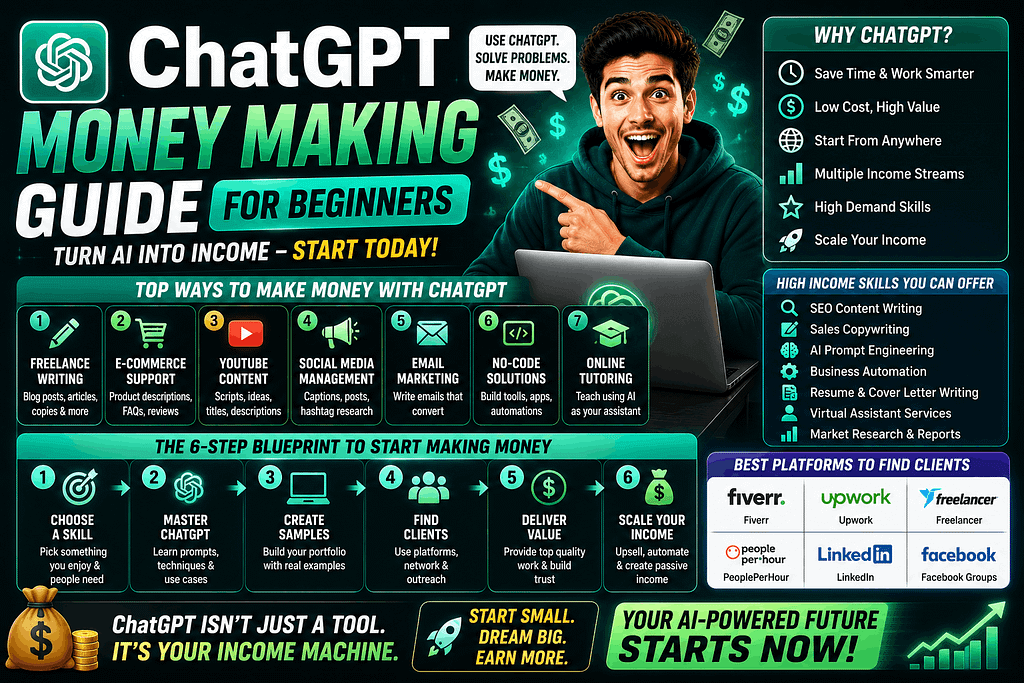
Once you’ve developed your skills, AI-assisted copywriting can become a freelance service.
You could offer:
Website Copy
Help small businesses improve their homepages, service pages, and landing pages.
Email Copywriting
Create newsletters and marketing sequences.
E-Commerce Copy
Write and optimize product descriptions.
Social Media Copy
Create captions and promotional content.
Ad Copy
Develop variations for digital advertising campaigns.
The key is selling the outcome and expertise rather than simply saying that you use AI.
A client isn’t paying because you have access to an AI tool. They’re paying because you can create effective marketing content.
How to Build an AI Copywriting Portfolio
You don’t need dozens of clients to get started.
Create several sample projects.
For example:
- A landing page for a fictional SaaS company
- Five product descriptions for an online store
- A seven-email welcome sequence
- Social media captions for a local business
- Several advertising concepts
Clearly label hypothetical projects as samples.
A strong portfolio should show your ability to understand a target audience and communicate benefits—not simply demonstrate that you can generate text.
Common AI Copywriting Mistakes
Publishing the First Draft
AI-generated copy often needs editing.
Making False Claims
Never allow AI to invent statistics, testimonials, guarantees, or product details.
Using Generic Language
If your copy could belong to any company, it probably needs more personality.
Ignoring the Customer
Effective copy starts with customer needs rather than technology.
Overusing AI
Some parts of copywriting require human creativity, judgment, and understanding.
Tips for Better AI Copywriting
To improve your results:
Give Specific Instructions
Provide useful context instead of vague prompts.
Provide Examples
Showing the AI the style or structure you’re aiming for can improve consistency.
Edit Aggressively
Remove unnecessary sentences and generic phrases.
Add Human Experience
Real examples and observations make copy more distinctive.
Verify Important Information
Fact-check claims before publishing.
Keep Your Brand Voice Consistent
Your website, emails, ads, and social posts should sound like they come from the same business.
Frequently Asked Questions
Is AI copywriting suitable for beginners?
Yes. Beginners can use AI to learn copywriting concepts, brainstorm ideas, and practice creating different types of marketing content.
Do I need to be a professional writer?
You don’t need years of experience to start learning. However, understanding basic copywriting, marketing, grammar, and audience research will make your work much stronger.
Can AI completely replace copywriters?
AI can automate portions of the writing process, but effective marketing still requires strategy, creativity, brand understanding, editing, and human judgment.
Can I make money with AI copywriting?
Yes, AI-assisted copywriting can be offered as a freelance service. Earnings vary based on skills, niche, pricing, experience, and client demand.
How can I make AI writing sound more human?
Add specific examples, original insights, brand personality, accurate details, and natural phrasing. Most importantly, edit the draft instead of publishing it unchanged.