
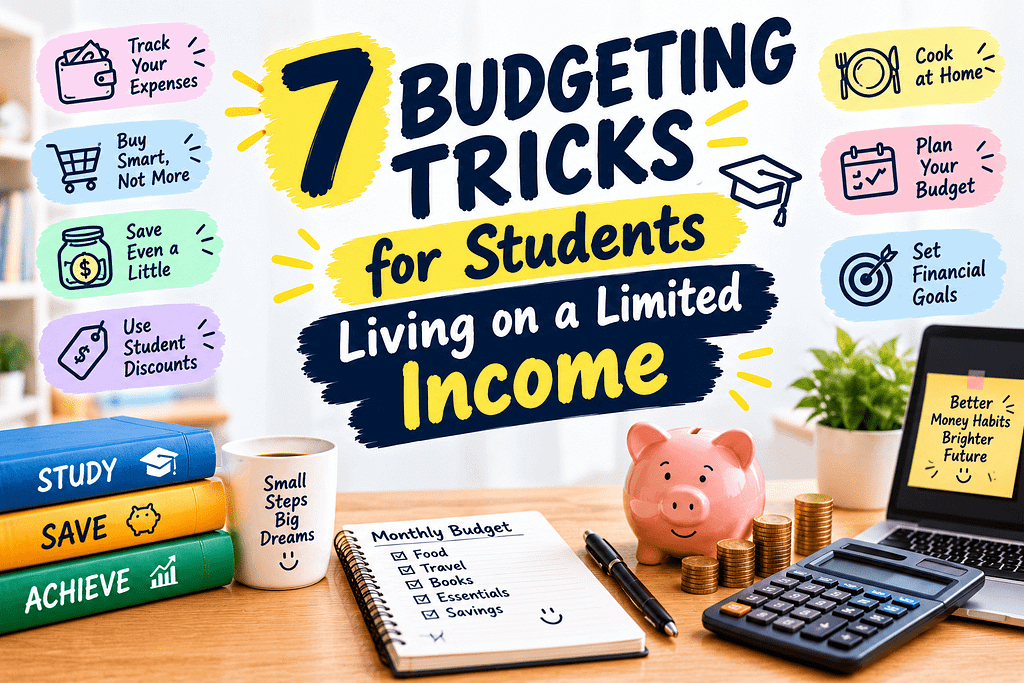
Being a student can be exciting, but managing money while studying isn’t always easy. Tuition, rent, groceries, transportation, textbooks, subscriptions, and the occasional coffee can quickly eat into a limited monthly income.
For students in the United States, the challenge can feel even bigger when you’re balancing college expenses with a part-time job, financial aid, family support, or an irregular income.
The good news is that you don’t need a huge salary to develop better money habits. A simple budget can help you understand where your money is going and make everyday spending decisions less stressful.
Here are seven practical budgeting tricks for students living on a limited income that can help you keep more of your money without making college life miserable.
1. Start With the Money You Actually Have
One of the biggest budgeting mistakes is creating a spending plan based on the money you hope to receive rather than the money you actually have.
Start by calculating your reliable monthly income.
This could include:
- Part-time wages
- Regular family support
- Scholarships or grants allocated for living expenses
- Other predictable income
- Consistent freelance or gig income
If your income changes every month, use a conservative estimate rather than your best month.
For example, if your part-time income ranges from $700 to $1,000, building your basic budget around $700 is safer. When you earn more, you can put the extra money toward savings, upcoming expenses, or debt.
The goal isn’t to predict your finances perfectly. It’s to avoid spending money today that you’ll need tomorrow.
2. Separate Needs From Wants
When money is tight, knowing the difference between a need and a want becomes extremely useful.
Needs might include:
- Rent or housing
- Basic groceries
- Utilities
- Transportation
- Required school supplies
- Essential healthcare expenses
Wants might include:
- Restaurant meals
- Entertainment subscriptions
- New clothes you don’t need
- Frequent coffee runs
- Impulse purchases
- Expensive weekend activities
This doesn’t mean you have to eliminate everything enjoyable.
Instead, give yourself a realistic amount for fun spending.
For example, if you have $100 available for optional spending during the month, you can decide how to use that money before you start spending it.
A budget works better when it gives you some freedom rather than making you feel like every purchase is forbidden.
3. Give Yourself a Weekly Spending Limit
Monthly budgets can sometimes feel too abstract.
You might know that you have $400 available for food and personal expenses, but that number doesn’t necessarily tell you how much you should spend today.
Breaking your budget into weekly amounts can make it easier.
Suppose you have $280 available for flexible spending in a month. Instead of thinking about the entire amount, you could set a target of roughly $65–$70 per week and leave some money as a buffer.
A weekly limit can help you notice problems earlier.
If you’ve spent almost your entire weekly allowance by Wednesday, you know it’s time to slow down before the weekend.
This is one of the simplest budgeting tricks for students living on a limited income because it turns a large monthly number into something you can actually monitor.
4. Make Food One of Your Biggest Savings Opportunities
Food can quietly become one of the largest expenses in a student’s budget.
Ordering delivery several times a week may seem harmless when each order is relatively small. But delivery fees, service charges, tips, and restaurant prices can turn those purchases into a significant monthly expense.
Try planning inexpensive meals before going grocery shopping.
You don’t need complicated recipes. Basic foods such as rice, pasta, eggs, beans, vegetables, oats, potatoes, chicken, or other affordable staples can form the foundation of many meals.
Before shopping, check:
What do I already have?
What will I actually eat?
Which items are on sale?
Can I use the same ingredients for multiple meals?
Students who have access to campus dining programs, food pantries, community resources, or other eligible assistance should also check what their school or local community offers.
Reducing food waste is another easy win. Buying something cheap isn’t saving money if it ends up in the trash.
5. Cancel Subscriptions You Barely Use
Subscriptions are easy to forget because the payments are often automatic.
A $10 or $15 monthly subscription may not seem important by itself. But several subscriptions can quietly become a significant expense over a year.
Go through your bank or card statements and make a list of recurring charges.
Ask yourself:
- Do I use this every month?
- Do I have another service that does the same thing?
- Can I use a free student version?
- Can I pause it until I actually need it?
- Is it worth the annual cost?
Students should also check whether they qualify for student pricing on software, entertainment, transportation, or other services.
You don’t necessarily need to cancel everything. The point is to stop paying for things that aren’t providing enough value.
6. Create a Small Emergency Buffer
When you’re living on a limited income, an unexpected $100 expense can feel enormous.
A flat tire, replacement textbook, medical expense, broken laptop accessory, or last-minute transportation problem can completely disrupt a tight budget.
That’s why even a small emergency fund can make a difference.
You don’t need to start with a huge savings target.
Your first goal could be $100.
After that, work toward $250, then $500, depending on your circumstances.
If you receive an unusually large paycheck, tax refund, gift, or other unexpected money, consider putting part of it aside instead of immediately spending all of it.
An emergency fund isn’t exciting, but it can prevent a small problem from turning into expensive credit card debt.
7. Use the 24-Hour Rule Before Buying Something Unplanned
Impulse spending is especially difficult when you’re constantly surrounded by online shopping, social media advertisements, and limited-time offers.
Before buying something that wasn’t already in your budget, wait 24 hours.
Ask:
Do I actually need this?
Would I still want it tomorrow?
Do I already own something similar?
Could I use that money for something more important?
Can I find it for less somewhere else?
The waiting period doesn’t mean you can never buy anything.
It simply creates a pause between wanting something and paying for it.
For larger purchases, consider waiting even longer.
Sometimes, what felt like an urgent purchase yesterday doesn’t seem nearly as important the next morning.
A Simple Student Budget Example
Imagine a student has $1,500 available each month after considering their regular income and support.
A simple starting plan might look like:
| Category | Example Amount |
|---|---|
| Housing & utilities | $700 |
| Food & groceries | $250 |
| Transportation | $100 |
| School expenses | $100 |
| Personal/fun spending | $150 |
| Savings/emergency fund | $100 |
| Buffer | $100 |
| Total | $1,500 |
These numbers are only an example. Housing costs vary dramatically across the United States, and every student’s situation is different.
The important part is assigning your money a purpose before it disappears through small purchases.
Don’t Try to Make Your Budget Perfect
A budget isn’t a punishment.
Your expenses will change. Your income may change. You may have an unexpected trip, school expense, medical bill, or social event.
Instead of abandoning your budget when something goes wrong, adjust it.
If you spend $40 more than planned on food this week, look at the rest of the month and decide where you can reasonably reduce spending.
The goal is progress, not perfection.
Final Thoughts
Learning how to manage money while you’re still in college can give you a valuable advantage after graduation.
These budgeting tricks for students living on a limited income don’t require complicated spreadsheets or advanced financial knowledge. Start by understanding your actual income, separating needs from wants, setting weekly spending limits, controlling food costs, reviewing subscriptions, building a small emergency fund, and delaying unnecessary purchases.
You don’t need to stop enjoying your student years.
You simply need to know where your money is going.
At Earnify05, we share practical personal finance, AI, productivity, and side-hustle ideas designed to help readers make smarter decisions with the money and resources they already have.