Studying doesn’t always mean spending more hours with your books. Sometimes, the real challenge is understanding a difficult concept, remembering what you learned, or figuring out where to begin with an assignment.
For students in the United States, ChatGPT can be a useful study assistant when it’s used thoughtfully. It can explain confusing topics, generate practice questions, help organize research, and suggest ways to improve writing.
But there’s a catch: if you ask AI to do every assignment for you, you may finish your work without actually learning much.
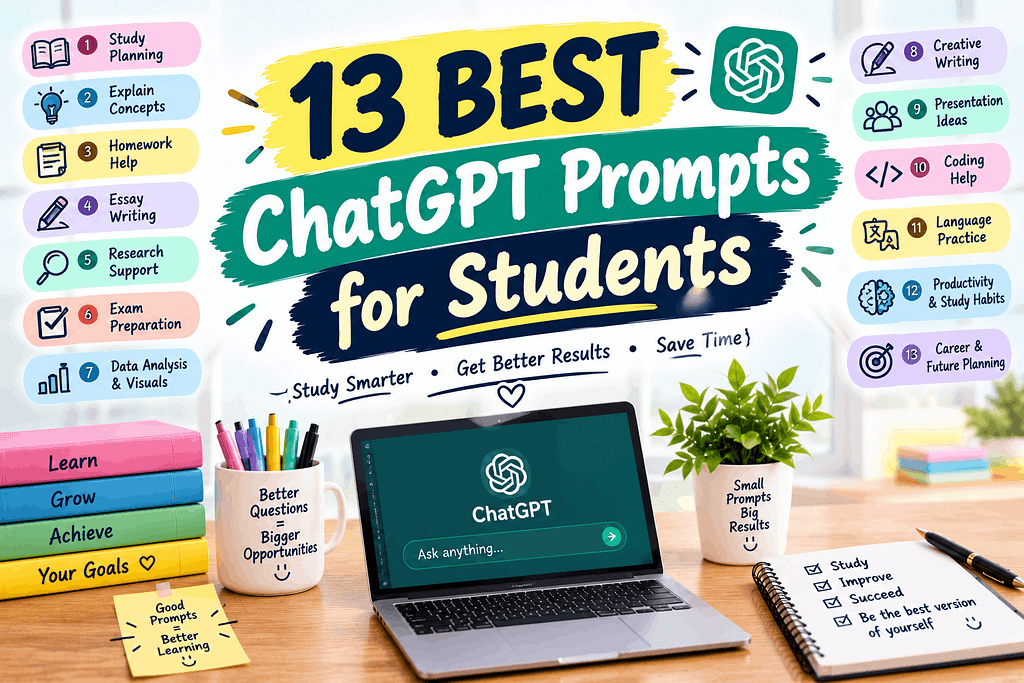
That’s why the best ChatGPT prompts for students should encourage you to think, practice, question, and solve problems independently. Here are 13 useful prompts you can adapt for high school, college, and university study.
1. Understand a Difficult Topic in Simple English
Sometimes a textbook explanation makes a simple idea seem unnecessarily complicated.
Use this prompt when you’re learning something new.
Prompt:
“Explain [topic] in simple English as if I am a beginner. Use a real-life example, explain the key terms, and finish with three questions to check my understanding. Don’t skip important details.”
Why it helps: You get a starting explanation before returning to your textbook or lecture notes. If something remains confusing, ask follow-up questions instead of memorizing an explanation you don’t understand.
2. Turn Your Notes Into Study Material
Long lecture notes can be difficult to revise, especially before an exam.
Prompt:
“Organize the following class notes on [subject] into clear headings, key concepts, important definitions, and short revision points. Preserve the important information and identify anything that seems unclear. Here are my notes: [paste notes].”
Why it helps: This is one of the most practical study prompts for turning scattered information into organized revision material.
Always compare the summary with your original notes to make sure important details haven’t been left out.
3. Create a Personalized Study Plan
Trying to study every subject at once can leave you feeling overwhelmed.
Prompt:
“Create a realistic 7-day study plan for my [exam name]. I have [number] subjects, can study for [hours] per day, and find [topics] difficult. Include revision, practice questions, short breaks, and time to review my mistakes.”
Why it helps: A plan gives you a clear starting point and helps you divide a large syllabus into manageable tasks.
Adjust the schedule around your classes, work, sleep, and other responsibilities. A realistic plan you follow is more useful than a perfect plan you abandon.
4. Generate Practice Questions for Exams
Reading a chapter repeatedly can make information feel familiar without proving that you can recall it independently.
Prompt:
“Create 15 practice questions about [topic] for a [grade or college course] student. Include multiple-choice, short-answer, and application-based questions. Put the answer key at the end, with brief explanations. Do not show the answers before the questions.”
Why it helps: You can test your understanding before looking at the solutions.
Try answering the questions without your notes first. Then review your mistakes and revisit the concepts you couldn’t explain.
5. Use AI as a Personal Tutor
Sometimes, you need more than a definition. You need someone to guide you through the reasoning.
Prompt:
“Act as my patient tutor for [subject]. Ask me one question at a time, wait for my answer, and give feedback. If I make a mistake, explain the misconception and give me a hint before showing the solution. Start with an easy question and gradually increase the difficulty.”
Why it helps: This turns ChatGPT into an interactive learning partner rather than a source of ready-made answers.
It’s particularly useful for mathematics, programming, science, and other subjects where understanding the steps matters.
6. Find Out What You Don’t Understand
You may know a chapter reasonably well but still have gaps in your understanding.
Prompt:
“Test my understanding of [topic] by asking me five questions, one at a time. After my answers, identify which concepts I understand and which ones I should revise. Explain the gaps and suggest a short practice activity for each one.”
Why it helps: It directs your study time toward weak areas instead of making you revise everything equally.
Be honest when answering. Guessing correctly doesn’t always mean you fully understand the concept.
7. Improve an Essay Without Losing Your Own Voice
AI can help you improve your writing without replacing your ideas.
Prompt:
“Review my essay about [topic] for clarity, structure, grammar, and logical flow. Do not rewrite the entire essay. First, identify three strengths and three areas for improvement. Then suggest specific edits while preserving my original ideas and voice. Here is my draft: [paste essay].”
Why it helps: You learn why a paragraph may be confusing and how to improve it.
Follow your school’s or college’s AI policy, especially when assignments must be completed independently or AI assistance must be disclosed.
8. Brainstorm Essay and Project Ideas
Starting an essay can be difficult when you have too many possible topics—or none at all.
Prompt:
“Suggest 10 focused essay or project ideas about [subject] suitable for a [grade or college course] student. For each idea, give a possible research question, why it matters, and two directions I could explore. Avoid topics that are too broad.”
Why it helps: You can compare ideas before choosing one that matches your assignment requirements and interests.
Use the suggestions as a starting point. Check your instructor’s instructions before finalizing your topic.
9. Learn How to Research a Topic
Research involves more than collecting paragraphs from different websites. You need to understand the question, evaluate evidence, and identify reliable sources.
Prompt:
“Help me plan research on [topic]. Suggest useful search terms, types of reliable sources to look for, questions my research should answer, and possible limitations or opposing viewpoints. Do not invent citations or claim that a source exists unless it can be verified.”
Why it helps: These research prompts can help you begin an assignment with a clearer plan.
Verify sources yourself through your library, academic databases, official reports, or reputable publications. Never submit an AI-generated citation without checking that the source exists and supports the claim.
10. Remember Important Information
If you keep forgetting definitions, formulas, or key facts, try active recall and spaced revision.
Prompt:
“Help me revise [topic] using active recall. Create 12 flashcards with a question on one side and a concise answer on the other. Group related concepts together and mark the five concepts I should prioritize based on the syllabus I provide.”
Why it helps: Flashcards encourage you to retrieve information from memory instead of simply rereading it.
Review difficult cards more often and return to them after increasing intervals.
11. Understand Difficult Math or Programming Problems
When you get stuck on a problem, seeing the final answer may not help you solve a similar question later.
Prompt:
“Help me solve this [math/programming] problem step by step. First, ask what I have tried. Then give me a hint about the next step instead of immediately providing the complete solution. Explain why each step works, and finish with a similar practice problem for me to solve independently. Problem: [insert problem].”
Why it helps: It encourages problem-solving instead of answer copying.
For programming, run the suggested code and test it yourself. For mathematics, verify calculations and practice another example without assistance.
12. Manage Assignments and Deadlines
Students often have several deadlines competing for their attention.
Prompt:
“Help me organize these assignments: [list tasks and deadlines]. Estimate the time needed for each, identify urgent tasks, and create a weekly schedule with realistic work sessions, breaks, and buffer time. Ask me for missing information instead of making unrealistic assumptions.”
Why it helps: You get a clear overview of what needs to be done and when.
Update the schedule when a task takes longer than expected. Productivity tools should reduce stress, not create another source of pressure.
13. Prepare for Presentations and Viva Questions
Presentations and oral exams require you to explain ideas clearly without depending entirely on written notes.
Prompt:
“Help me prepare for a presentation or viva on [topic]. Generate 15 questions, starting with basic definitions and moving to more challenging application questions. Ask one question at a time, evaluate my answer, and suggest how I can explain it more clearly. Include follow-up questions that test my understanding.”
Why it helps: Practicing aloud can reveal whether you truly understand your project or subject.
For college projects, prepare to explain your own methods, tools, results, limitations, and decisions in your own words.
How to Use ChatGPT Without Becoming Dependent on It
The goal isn’t to use AI for every part of your education. It’s to become a more independent learner.
Follow these simple habits:
- Try first, ask second. Attempt the question before requesting a hint.
- Use hints before full solutions. Give yourself a chance to reason through the problem.
- Verify important information. AI can make mistakes or confidently present incorrect details.
- Practice without AI. Close the chat and explain the concept from memory.
- Follow academic rules. Check your school’s policy on AI assistance, citations, and permitted tools.
- Protect your privacy. Don’t upload personal records, private student information, or confidential course material without permission.
AI should help you build your skills, not quietly replace the thinking that develops them.
Final Thoughts
The best ChatGPT prompts for students are the ones that help you understand a subject, recognize mistakes, and practice until you can work independently.
Use ChatGPT prompts for study planning, learning, homework guidance, essay improvement, research, communication, and exam preparation. But remember that a good answer is not the same as genuine understanding.
Try one prompt from this list during your next study session. Make an attempt yourself, ask AI for useful feedback, and then solve a similar problem without help.
That final step is where the learning becomes your own.
At Earnify05, we share practical ideas about AI, productivity, personal finance, and smarter ways to work and learn.