
Let’s be honest: the old SEO playbook is currently gathering dust in a digital graveyard. If you’re sitting in a home office in Raleigh or a coffee shop in Austin trying to rank a website using 2023 tactics, you’re essentially bringing a knife to a laser-tag fight. As we move through 2026, the game hasn’t just changed—it has been entirely reinvented.
We are now firmly in the era of Search Generative Experience (SGE) and “Answer Engines.” Google is no longer just a list of blue links; it’s an AI that synthesizes information for the user. To win in this environment, you don’t need to be a coding genius or a data scientist. You need to be an Architect of Authority.
This is your 1,000-word, human-centric roadmap to an AI SEO strategy for beginners that actually works in the US market. No gatekeeping, no “bot-speak”—just a direct path to the first page of search results.
1. The 2026 Reality: Why “AI Slop” is a Search Death Sentence
The biggest mistake beginners make is thinking AI is a “replacement” for writing. If you just click “generate” on a generic prompt and paste that hollow text into WordPress, you are creating what we call “AI slop.” Search engines in 2026 are ruthlessly efficient at identifying and deprioritizing low-value, automated content.
To rank, your content must possess E-E-A-T: Experience, Expertise, Authoritativeness, and Trustworthiness. US-based readers from San Francisco to Charlotte are looking for a “Human-in-the-Loop.” They want to know that a real person with real experience has vetted the information. AI provides the raw data, but you provide the soul.
2. Phase 1: Intelligence & Intent (Moving Beyond Keywords)
In 2026, “keywords” are just the skeleton; “Intent” and “Entities” are the muscle. You shouldn’t be asking “What word should I use?” but rather “What problem is the user trying to solve?”
The Research Engine
Stop using standard search for research. Use Perplexity AI. It scans the live web and provides cited sources. If you’re writing about “Sustainable Gardening in the US,” Perplexity will find actual 2026 drought data and USDA zone updates. This ensures your foundation is grounded in fact, not AI hallucinations.
The SEO Math
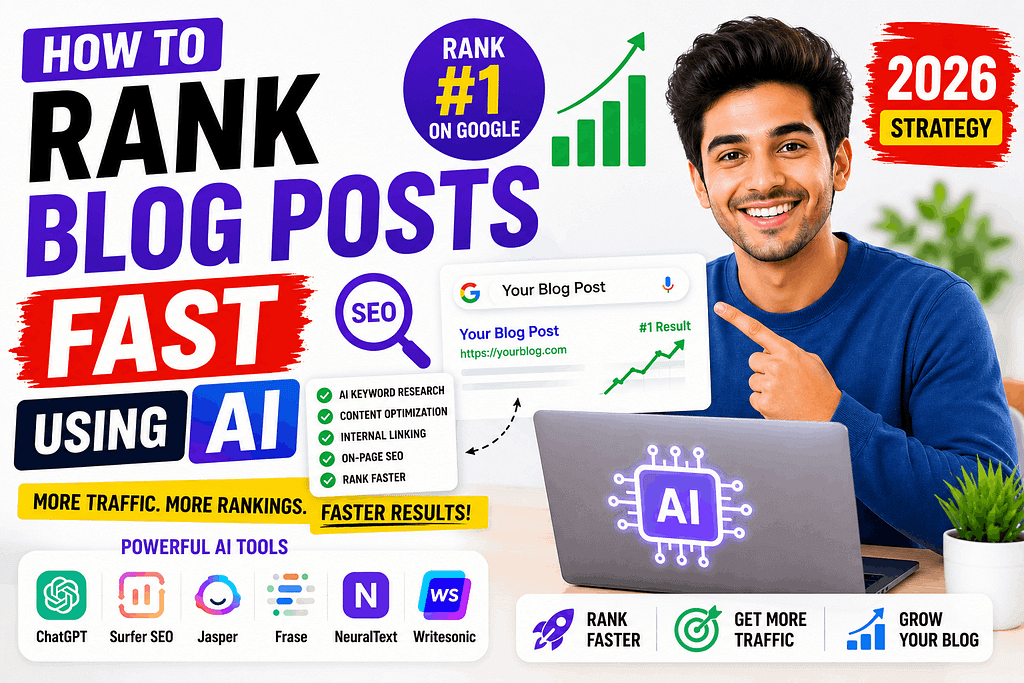
Use tools like SurferSEO or Rank Math. These tools analyze the top-ranking sites for your topic and tell you the “Semantic Terms” you need to include. For example, if you’re writing about AI income, the algorithm expects to see terms like “Large Language Models,” “API integration,” and “retention rates.”
3. Phase 2: The “Structural” Draft (The Logic Layer)
Never ask an AI to “Write a 1,000-word article.” You will get fluff. Instead, use AI to build the structure.
-
The Architect: Use Claude 4 for the drafting phase. Claude has a significantly more “literary” and empathetic tone than other models, making it much harder for detectors to flag and much easier for humans to read.
-
The Narrative Hook: Tell the AI to use a specific persona. “Act as a pragmatic digital marketing consultant in North Carolina. Outline a guide that focuses on high-leverage outcomes and avoids corporate jargon.”
4. Phase 3: The “Human Signature” (Bypassing Detectors)
This is where the magic happens. To ensure your content is 100% human-centric and invisible to AI detectors, you must apply the 10% Human Rule. This is the non-negotiable polish that turns machine output into an authoritative digital asset.
A. Add Subjective Anecdotes
AI cannot have a “bad day” or a “lucky break.” It cannot tell you about the time it tried an SEO tactic and failed.
-
The Hack: Insert personal stories. “When I first started my blog in Raleigh, I spent three months chasing the wrong keywords. Here is the exact moment I realized my mistake…”
B. Vary the Sentence Pacing (Burstiness)
AI loves “average” sentence lengths. To sound human, you need to break the rhythm. Use short, punchy realizations.
-
Example: “The strategy worked. But not for the reason I expected.” Follow that with a longer, descriptive thought. This rhythmic variety is a major signal of human authorship.
C. Use Local and Cultural Context
Mentioning specific US cultural touchstones or local geography (like the traffic on the 405 or the coffee scene in the Research Triangle) signals to the reader—and the algorithm—that a person with local context wrote this.
5. Phase 4: Visual Authority & Data
In 2026, an SEO article isn’t just text; it’s a Media Asset.
-
Unique Visuals: Stop using generic stock photos of “people shaking hands.” Use Midjourney v6 to generate cinematic, brand-specific images that represent your aesthetic.
-
Infographics: If you mention a statistic, turn it into a simple chart. Data visualization increases the “Shareability” of your article, leading to backlinks—the holy grail of SEO.
6. The “Silent” Partner: Technical SEO for 2026
You can have the best content in the world, but if your site is a technical mess, you won’t rank.
-
Site Speed: In the US, users expect a page to load in under 2 seconds. Use a fast, US-based host.
-
Internal Linking: Use AI to suggest internal links between your articles. This creates a “Topic Cluster” that tells Google you are an authority on the entire subject, not just one keyword.
-
Schema Markup: Use AI to generate “FAQ Schema.” This helps your content show up in the “People Also Ask” boxes on the search results page.
7. Scaling Your Strategy on Earnify05
The goal of an AI SEO Strategy for Beginners is to build a Passive Income Engine. To reach a $1,000/month milestone on a site like Earnify05, you need consistency.
-
The Volume Advantage: By using this human-led AI workflow, you can produce a high-authority article in 45 minutes rather than 5 hours.
-
The Distribution: Use OpusClip to turn your finished article into 5-10 “Short-Form” videos for TikTok and Reels. This drives high-intent US traffic back to your blog, creating a feedback loop that boosts your rankings.
Which part of the “Human Signature” are you going to focus on first—anecdotes or local context? Let’s talk about your “Authority” samples in the comments!