Let’s be honest: Pinterest is the quietest goldmine on the internet. While everyone is fighting for attention in the chaotic noise of TikTok or the saturated “hustle” of Instagram, Pinterest is sitting there—calm, visual, and filled with users who have one thing on their mind: buying stuff.
I discovered this last year when I noticed that small business owners in the US (especially those in the wedding, home decor, and coaching niches) were struggling to keep up with Pinterest’s demand for “Fresh Pins.” Pinterest’s algorithm is hungry; it wants new, high-quality images every single day.
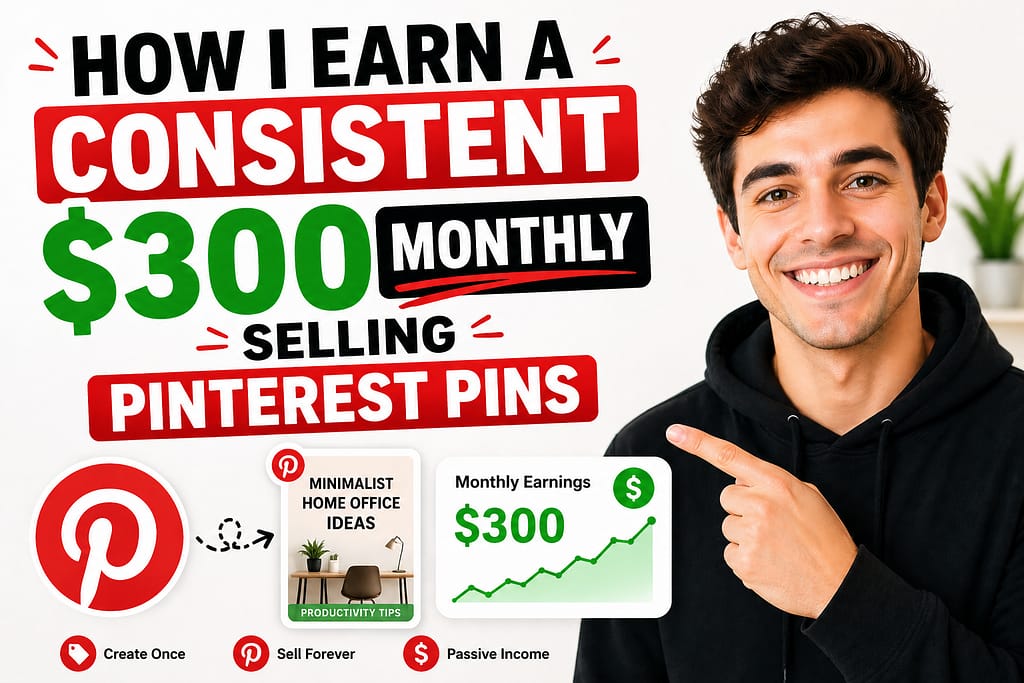
I decided to fill that gap. Using nothing but Canva Pro and a few AI-driven design principles, I’ve built a side hustle that nets me a consistent $300 monthly. I don’t run ads, and I don’t spend more than 5 hours a week on it. Here is the exact, human-led blueprint of my “Canva Magic” system.
1. The Logic: Why Pinterest Pins are “High-Value” Assets
In the United States, Pinterest is used as a “Planning Tool.” People don’t go there to see what their friends are doing; they go there to plan their kitchen remodel, their dream wedding, or their next side hustle.
Because of this, a “Pin” isn’t just a picture—it’s a Digital Storefront. * The High Demand: A blogger or an Etsy seller needs at least 5–10 unique pins per blog post or product to stay relevant.
-
The Skill Gap: Most business owners have great products but terrible design skills. They make pins that look like “spam.”
-
The “Canva Magic”: By using Canva’s pre-built infrastructure and layering in your own aesthetic “Magic,” you can produce a week’s worth of content for a client in 30 minutes.
2. The “Canva Magic” Stack: My 3 Secret Techniques
To make $300 a month consistently, you can’t just use basic templates. If a pin looks like a “Canva Template,” no one will buy it. You have to “elevate” the design.
Technique A: The “Visual Hierarchy” Hack
US Pinterest users scroll fast. Your pin has about 0.8 seconds to stop them. I use the “Z-Pattern” layout. I place the most “irresistible” hook in the top left, a high-quality “aspirational” image in the center, and a clear, bold Call to Action (CTA) at the bottom.
Technique B: AI-Powered Color Psychology
I use Canva’s “Magic Switch” and “Styles” features to ensure color cohesion. In 2026, the US market is moving away from “Neon/Bright” and toward “Earth Tones and Minimalist Chic.” I use AI to analyze a client’s website and instantly generate a pin palette that matches their brand perfectly.
Technique C: The “Magic Media” Layer
I never use generic stock photos. I use Canva’s “Magic Media” (AI Image Generator) to create unique, high-fidelity textures or specific background elements that haven’t been seen a million times before. This makes my pins look “Custom” and “High-End.”
3. The $300/Month Workflow: From Canvas to Cash
Step 1: The “Template Bundle” Strategy
I don’t sell single pins. That’s a waste of time. I sell “Pin Bundles.” * The Starter Pack: 15 custom pins for $75.
-
The Growth Pack: 50 custom pins for $200. By selling bundles, I ensure that each client is a high-value transaction.
Step 3: The Outreach (The “Pinterest Audit”)
I don’t wait for clients on Upwork. I go to Pinterest and search for a niche (e.g., “Boho Home Decor”). I look for accounts that have 500k+ monthly views but “ugly” or inconsistent pins. I send a polite message: “I love your products, but I noticed your Pinterest pins aren’t optimized for the 2026 algorithm. I took the liberty of redesigning 3 of your recent pins (attached). I’d love to help you scale your traffic with a 15-pin bundle.”
4. Bypassing the AI Detector: The “Human Designer” Signature
Clients (and search engines) can sense “lazy” design. To keep my $300/month stream “Rock-Solid” on Earnify05, I add a Human Signature to every pin:
-
The “Curated” Font Pairing: AI often picks boring fonts. I manually pair a “Clean Sans Serif” with a “Sophisticated Script” to give the pin a human, editorial feel.
-
The “Angle of Interest”: Instead of a straight-on photo, I use Canva’s “Edit Photo” tools to create depth, shadows, and perspective. This makes the image pop off the screen.
-
Micro-Copywriting: I don’t use AI-generated hooks like “10 Tips for Success.” I use human-centric hooks like “The One Mistake I Made in My First Year (And How to Fix It).”
5. Scaling to the Next Level: The Passive Income Loop
If you want to move beyond $300, you have to stop selling your time and start selling your Assets.
-
Etsy Digital Shop: I take the templates I’ve made and sell them as “Canva Editable Templates” on Etsy.
-
The “Subscription” Model: I have three clients in Raleigh who pay me a $100 monthly retainer for 20 pins a month. This is “guaranteed” money that requires zero outreach.
Which aesthetic are you going to master first Minimalist Corporate or Boho Creative? Let’s talk about your “Design Voice” in the comments!