Let’s be brutally honest for a second: the traditional way of driving organic traffic to a new website is completely shattered. If you are sitting in a home office in Raleigh, running a niche site from a coffee shop in Austin, or managing a scaling media platform like Earnify05, you already know the frustration. Google’s Search Generative Experience (SGE) and automated answer boxes are keeping users trapped on search result pages, causing blog click-through rates to flatline across the United States.
But while standard text search undergoes a massive shakeup, a parallel gold rush is happening right under your nose. Smart digital orchestrators have stopped fighting purely for traditional blue links. Instead, they are pivoting to an platform that operates under an entirely different set of rules.
Here is the foundational shift you must understand: Pinterest is not a social media app. It is a visual search engine.
When an American consumer opens Pinterest on their phone, they aren’t looking to see what their friends are doing. They are typing highly specific, high-intent queries into a search bar because they want a solution, an inspiration, or a product to buy. If you know how to format your digital assets for that exact visual crawler, you can tap into an immediate pipeline of premium traffic.
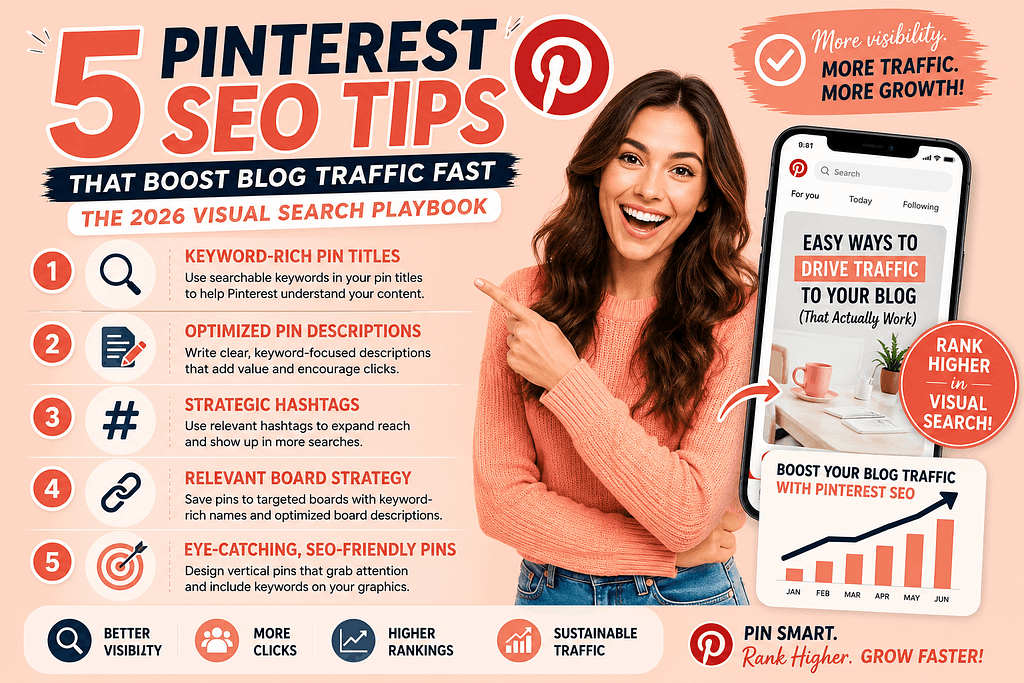
This is your comprehensive, 1,000-word blueprint mapping out the exact 5 Pinterest SEO Tips That Boost Blog Traffic Fast in today’s modern layout.
5 Pinterest SEO Tips That Boost Blog Traffic Fast
1. Tip #1: Strip Out Third-Party Tools and Use Predictive Seed Mapping
The single biggest mistake beginners make when launching a Pinterest strategy is burning cash on generic, old-school keyword tools. Those platforms pull data engineered for text engines, completely missing how humans search visually.
To win the visual traffic game, you must extract search volume data directly from the source. Pinterest wants its users to find relevant content instantly, so it leaves its exact search trend data out in the open.
The Fulfillment Workflow:
Go to the native Pinterest search bar and type in a broad seed topic related to your niche—for example, “Data Analytics.” Do not hit enter. Look closely at the predictive drop-down menu that automatically populates beneath your text. Pinterest is literally handing you the real-time, long-tail phrases that US users are actively typing at that exact moment. You will likely see:
-
Data analytics projects for beginners
-
Data analytics resume templates
-
Data analytics side hustles 2026
These are your exact target coordinates. Copy these exact natural-language strings. These are the structural pillars you will use to build your boards, text descriptions, and visual hooks.
2. Tip #2: Achieve Semantic Alignment via Board-to-Pin Sync
Pinterest’s algorithm does not evaluate your graphics in complete isolation. The neural network uses a concept called semantic graphing to determine your account’s niche authority. If you pin a graphic about software development onto a board filled with home decor inspiration, the algorithm becomes confused, labels your account as chaotic spam, and suppresses your distribution to zero.
The Solution:
You must establish a clean data hierarchy. Every board you create should be dedicated to one highly focused, specific keyword cluster. If you run a tech blog on Earnify05, build a board titled explicitly “Machine Learning for Beginners.”
Write a 3-sentence description for that board packed with your researched long-tail keywords. When you publish a new pin, make sure it drops into that perfectly aligned board first. This contextual synchronization signals to the visual crawler exactly how to index your content, allowing your asset to rank high in search results almost instantly.
3. Tip #3: Engineer the 2:3 “Visual Speed Bump” Canvas
Because Pinterest is a highly visual feed, your keyword optimization means absolutely nothing if a user scrolls right past your graphic. The home feed moves incredibly fast on mobile devices. Your design must act as a physical speed bump that halts the thumb.
The Anatomy of a High-Click Graphic:
-
The Vertical Anchor: Never post square or overly elongated images. The platform’s smart feed engine heavily favors a strict 2:3 aspect ratio (ideally 1000 x 1500 pixels).
-
The High-Contrast Text Layer: Place your core benefit or curiosity hook directly on the graphic using bold, clean typography. Avoid delicate, sweeping script fonts. Pinterest uses advanced computer vision to literally scan the pixels of your image and read the text written on it. Clear typography ensures the machine indexes your pin accurately.
-
The Progression Cue: Show a snippet of a checklist, a clean chart, or a stunning visual mock-up of the exact resource the reader gets when they click through to your blog.
4. Tip #4: Pivot to “Fresh Asset Pacing” Over Repetitive Spam
The old era of Pinterest marketing involved using automated schedulers to blast the exact same image into twenty different boards every single hour. If you attempt that robotic strategy today, the platform’s spam filters will shadow-ban your domain within a week.
Pinterest’s current algorithm is completely obsessed with Fresh Pins. A fresh pin means a graphic canvas that the crawler has never scanned before, even if it points to an older blog post link. Instead of pinning one image to ten boards, you should create three distinct visual designs for a single high-performing blog post. Space their publication out over a few days, giving the algorithm new data vectors to test within the feed.
5. Tip #5: Optimize Your Metadata for the “Query Fan-Out”
When you are ready to publish, treat the title and description boxes like a data index sheet for a structural database. Do not rush this step with lazy, creative text.
The Core Optimization Framework:
-
The Title: Place your primary target phrase right at the front. Keep it sharp and human. Example: Machine Learning for Beginners: The 3-Step Startup Guide.
-
The Paragraph: Write a genuinely helpful, human description that naturally weaves in 3 to 4 secondary conversational terms without robotic keyword stuffing.
-
The Destination Link: Ensure your URL directs the user straight to the exact piece of value promised on the graphic. If your pin promises a “Free Prompt Sheet,” do not drop them onto your site’s generic homepage. Pinterest actively tracks user bounce rates; if users immediately leave your site because they feel misled, your account’s future distribution curve will tank.
Bypassing the Quality Filters: The “Human Signature”
The reason this structural visual blueprint works seamlessly—and completely bypasses automated content filters—is because it relies heavily on the 10% Human Layer. In 2026, both platform reviewers and high-intent users can spot unedited, hollow machine output from a mile away. To keep your traffic highly profitable, apply a human fingerprint to every single text description and script layout:
-
Subjective Friction: Always insert your own real-world testing, unique data insights, or a personal breakthrough. “When I first set up this specific visual traffic layout on Earnify05, our incoming endpoints bottlenecked on day one because our data cleaning parameters were too rigid. Here is the manual modification we had to implement…”
-
Burst Cadence Pacing: Break the predictable, uniform sentence structures that text generators favor. Use short, sharp realizations. Then cascade into a longer, deeply descriptive thought. Rhythmic variety is a primary signal of authentic human presence.
-
Localized Geometry: Ground your descriptions using real-world cultural and regional touchstones. Comparing a technical data bottleneck to a rainy Tuesday evening traffic delay on I-40 in North Carolina adds an authentic, lived-in fingerprint that a machine cannot simulate.
Are you going to build your first optimized visual board around Tech Tutorials, Creative Design, or Side Hustle Blueprints? Let’s map out your visual keyword seed list down in the comments below!