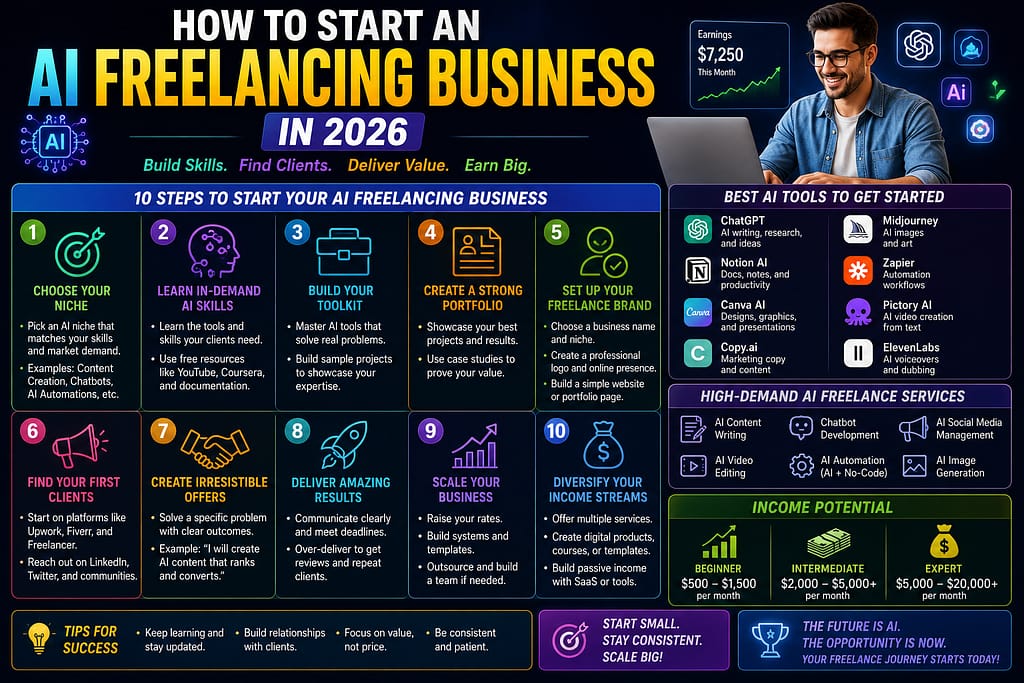
Artificial intelligence has changed the way businesses work. Tasks that once took several hours can now be completed much faster with the right combination of AI tools and human expertise. This shift has created an interesting opportunity for freelancers who can help businesses use AI effectively.
If you’ve been wondering How to Start an AI Freelancing Business, you don’t necessarily need to be a programmer or AI researcher. What matters more is understanding a specific business problem and knowing how to use technology to solve it.
From content creation and marketing to automation and research, AI freelancing can be built around many different skills. The key is to provide useful results rather than simply selling access to an AI tool.
In this guide, Earnify05 explains how beginners can build an AI-focused freelance business step by step.
What Is AI Freelancing?
AI freelancing means providing professional services with the help of artificial intelligence.
A freelancer might use AI to:
- Create and edit marketing content
- Automate repetitive workflows
- Analyze information
- Generate design concepts
- Assist with research
- Improve business processes
- Create customer-support systems
The freelancer remains responsible for strategy, quality control, communication, and the final result.
This distinction is important. Clients generally don’t want someone who simply knows how to type prompts. They want someone who can solve a problem.
Step 1: Choose One AI Freelancing Niche
The first step in How to Start an AI Freelancing Business is deciding what service you want to offer.
Avoid trying to become an expert in everything.
Consider services such as:
AI Content Services
You could help businesses create blog outlines, newsletters, product descriptions, or social media content, while adding human editing and brand strategy.
AI Automation
Businesses often have repetitive processes that can be streamlined using AI and automation platforms.
AI-Powered Research
You can help clients organize information, summarize documents, research competitors, or prepare reports.
AI Marketing Services
AI can assist with campaign ideas, email marketing, content planning, and advertising workflows.
AI Productivity Consulting
You can help professionals integrate AI into everyday tasks to save time and improve organization.
Choose one area that matches your existing skills and interests.
Step 2: Learn the Tools Behind Your Service
Once you’ve chosen a niche, learn the tools that support it.
For example, an AI content freelancer might learn:
- AI writing assistants
- SEO tools
- Content management systems
- Editing software
An automation freelancer might learn:
- Workflow automation platforms
- AI APIs
- Spreadsheet integrations
- CRM systems
You don’t need dozens of tools. A small toolkit that you understand deeply can be more valuable than a long list of subscriptions.
Step 3: Define a Specific Client Problem
A common beginner mistake is creating a service around a tool rather than a problem.
Instead of saying:
“I provide AI services.”
Make your offer specific.
For example:
“I help small businesses automate repetitive customer-support tasks.”
Or:
“I help online stores create and manage SEO product content.”
A specific offer makes it easier for potential clients to understand why they should hire you.
Step 4: Build a Portfolio Before Looking for Clients
You don’t need a long list of previous clients to create your first portfolio.
Build sample projects that demonstrate what you can do.
For example:
- Create a sample marketing campaign.
- Build an automated workflow.
- Write a sample SEO article.
- Design an AI-assisted content system.
- Create a customer-support chatbot concept.
Explain the problem, your process, and the expected business benefit.
A good portfolio demonstrates your thinking—not just the final output.
Step 5: Set Your Freelance Pricing
Pricing can feel difficult when you’re starting out.
Instead of immediately trying to charge premium rates, start with prices that reflect your current experience and gradually increase them as your portfolio and reputation improve.
You can charge:
- Per project
- Per package
- Per hour
- Monthly retainer
For example, rather than charging separately for every social media post, you could create a monthly content package that includes planning, creation, editing, and scheduling.
Packages make your service easier for clients to understand.
Step 6: Find Your First AI Freelance Clients
Once your service and portfolio are ready, start looking for potential clients.
Useful channels include:
- Freelance marketplaces
- Business communities
- Professional networking
- Referrals
- Direct outreach
- Your personal website
Don’t send hundreds of generic messages.
Research the business first and identify a genuine problem you could help solve.
A personalized message is more likely to get attention than a copy-and-paste sales pitch.
Step 7: Deliver More Than AI Output
This is where many AI freelancers can differentiate themselves.
Don’t simply give clients raw AI-generated material.
Instead:
- Understand the client’s objective.
- Research the audience.
- Use AI to speed up production.
- Fact-check the output.
- Edit and refine the result.
- Match the client’s brand voice.
- Deliver the finished work professionally.
Your value comes from the entire process.
Step 8: Create Repeatable Workflows
Once you have completed several projects, document your process.
For example:
Client request → Research → AI-assisted production → Human review → Quality check → Delivery
A repeatable workflow allows you to complete projects faster while maintaining consistent quality.
Automation can also handle repetitive administrative tasks such as scheduling, notifications, file organization, and follow-up emails.
Step 9: Build Long-Term Client Relationships
Finding a client is only the beginning.
Long-term clients can provide more predictable income than constantly searching for new projects.
After completing a project, look for additional ways to help.
For example, a client who hires you for AI content might also need:
- SEO optimization
- Content planning
- Social media repurposing
- Email marketing
- Workflow automation
The goal isn’t to sell unnecessary services. It’s to become a reliable partner who understands the client’s business.
Mistakes New AI Freelancers Should Avoid
When learning How to Start an AI Freelancing Business, keep these mistakes in mind.
Don’t Promise Unrealistic Results
Avoid guaranteeing specific revenue or growth figures you cannot control.
Don’t Rely Entirely on AI
AI output can contain errors, outdated information, or poor recommendations. Human review remains essential.
Don’t Learn Every Tool
Technology changes quickly. Focus on tools that directly support your service.
Don’t Compete Only on Price
Low prices can make it difficult to build a sustainable business. Focus on quality, reliability, and measurable value.
Don’t Ignore Communication
A technically impressive service can still fail if you don’t communicate clearly with clients.
How to Grow Your AI Freelancing Business
After establishing your first clients, you can gradually scale.
Consider:
- Raising your rates
- Creating service packages
- Offering monthly retainers
- Building a personal brand
- Creating educational content
- Developing digital products
- Automating administrative tasks
- Asking satisfied clients for referrals
Over time, you can move from selling individual tasks toward selling complete solutions.
Frequently Asked Questions
Can beginners start an AI freelancing business?
Yes. Beginners can start by learning one useful AI workflow and offering a focused service. Building real skills and a portfolio is more important than having dozens of AI certifications.
Do I need coding skills?
Not always. Many AI freelance services, including content, marketing, research, design, and productivity consulting, can be performed without advanced programming.
How much can an AI freelancer earn?
Income varies widely depending on expertise, niche, pricing, location, client demand, and experience. There is no guaranteed income level.
Where should I find my first client?
Start with your existing network, LinkedIn, freelance platforms, local businesses, and personalized outreach. A small successful project can become the foundation for future referrals.
Is AI freelancing a good side hustle?
It can be. Freelancing allows you to begin with individual projects and gradually increase your workload as your skills and client base develop.