Let’s be brutally honest for a second: the corporate sales world is currently experiencing a massive crisis of connection. If you’re sitting in a home office in Raleigh or a coffee shop in Austin trying to close business clients by blasting them with clinical spreadsheets, feature lists, and dry technical proposals, you are essentially shouting into a void.
As we navigate through 2026, logic-based pitching has hit a wall of absolute saturation. Thanks to the explosion of automated outbox tools, the average US business owner’s inbox is flooded with dozens of templated, robotic sales pitches every single day. They don’t want to read another generic breakdown of your deliverables, and they certainly don’t care about the complex software infrastructure you use to run your agency or your digital dashboard on Earnify05.
The human brain does not make high-ticket purchasing decisions based on features; it makes them based on feelings. Logic is merely the tool we use to justify an emotional decision after the fact. If you want to scale your freelance business, secure premium retainers, and out-compete corporate giants, you need to stop acting like a technical vendor and start acting like an Emotional Architect.
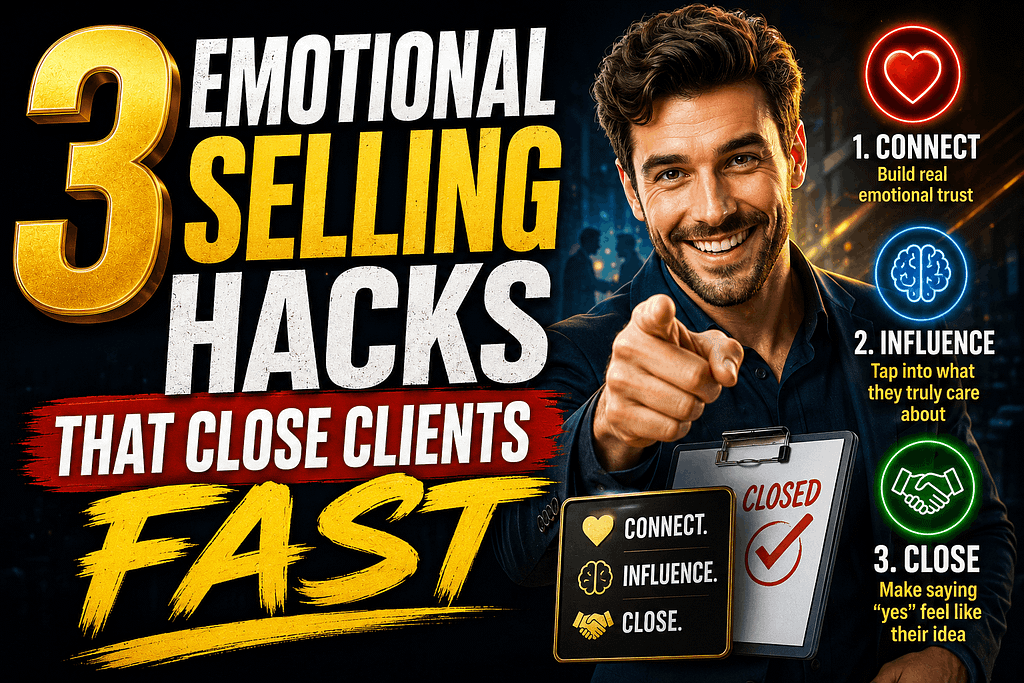
Whether you are selling local SEO optimization, high-end short-form video production, or automated administrative pipelines, this 1,000-word guide breaks down the 3 emotional selling hacks that close clients fast in today’s competitive US market.
1. The Psychology of Conversion: Logic vs. Emotion
Before we dive into the specific tactical hacks, we have to look at the underlying neurological mechanics of a high-value transaction. Traditional sales training tells you to focus on ROI (Return on Investment). You are taught to build mathematical arguments: “If you pay me $500, I will save your staff 10 hours of manual data sorting, which equals a net gain of $200.”
While that math sounds perfectly reasonable on paper, it completely misses the primal human driver. A busy business manager doesn’t lie awake at 2:00 AM worrying about abstract fractional percentages of operational efficiency. They lie awake worrying about status, security, time, and freedom.
To bridge this gap, your sales conversations must shift from functional descriptions to high-arousal emotional anchors. You must connect your service directly to a core human desire.
2. Hack #1: The “Righteous Indignation” Shift (Exposing the Hidden Enemy)
Anger and frustration are two of the highest-arousal emotions in the human psyche. When a prospect feels like they are being quietly taken advantage of by an invisible system or a shifting market, they don’t just lean in—they demand a solution.
The Strategy:
With the widespread rollout of Google’s Search Generative Experience (SGE) and AI Overviews, thousands of local US businesses have watched their legacy website traffic collapse. They are terrified, confused, and feel completely helpless against the algorithm.
Instead of walking into a pitch saying, “I can fix your search visibility,” you expose the injustice. Frame the situation as a direct conflict: “Your business has spent ten years serving this community, building real authority, and earning five-star reviews. But right now, automated tech networks are quietly scraping your data and pushing your website down the page to keep users trapped in their own layout. It isn’t fair that low-quality copycat sites are getting cited ahead of your real-world expertise.”
The Emotional Payout:
This instantly shifts the dynamic from a boring procurement pitch to a joint mission. You are no longer a contractor trying to pull money out of their marketing budget; you are a trusted ally helping them launch a counter-offensive against an unfair market shift.
3. Hack #2: Agitating the “Invisible Friction” (The True Cost of Inaction)
Human beings are biologically wired to avoid pain far more aggressively than they pursue pleasure. In behavioral economics, this is known as loss aversion. If you tell a prospect how much money they could make by working with you, they feel a mild sense of desire. But if you show them exactly how much life, time, and sanity they are actively bleeding out every single day by doing nothing, they will move mountains to stop the leak.
The Strategy:
Identify the most exhausting, soul-crushing administrative bottleneck your prospect deals with. If you are pitching a custom B2B data-cleaning prompt pipeline on Earnify05 to a boutique consulting firm, do not talk about the formatting code. Talk about the exhaustion.
During your discovery call, dig deep into the daily routine: “Walk me through what happens at 5:00 PM on a Friday when a wave of chaotic client intake notes hits your desk. How much time does your administrative assistant spend manually copy-pasting those text blocks into spreadsheets? What does that cost your business in human errors, delayed follow-ups, and pure staff burnout? How much mental energy are you personally wasting reviewing broken formatting when you should be at home having dinner with your family?”
The Emotional Payout:
By mapping the problem directly to real-world emotional fatigue, you transform a vague software concept into an urgent rescue mission. The business owner realizes that every day they delay hiring you is another day they are willingly trapping themselves in a loop of administrative frustration.
4. Hack #3: Future Pacing the “Status and Identity” Anchor
Every business professional carries a distinct vision of their ideal corporate identity. They want to be viewed by their peers, competitors, and clients as forward-thinking market leaders, innovators, and strategic orchestrators. No one wants to feel left behind, obsolete, or out of touch.
The Strategy:
This hack relies on visual and narrative future pacing. You walk the prospect through a vivid mental simulation of what their business, reputation, and lifestyle will look like after your system is fully integrated.
If you are pitching a short-form video extraction retainer using tools like OpusClip Pro, bypass the editing timeline talk entirely. Say this: “Imagine three weeks from now. Your LinkedIn feed and YouTube channel are consistently pulsing with professional, high-retention vertical clips showing your top industry insights. Your local competitors are looking at your brand, wondering how you managed to scale up a high-end digital media presence overnight without hiring a Hollywood production crew. You walk into your next client consultation, and before you even open your laptop, the client says, ‘I’ve been seeing your short-form clips everywhere this month—you guys are clearly leading the space.'”
The Emotional Payout:
You are no longer selling video clips or tech labor. You are selling status, authority, and industry relevance. You are offering them the exact digital identity they have been craving, packaged as a simple, done-for-you workflow.
5. Bypassing the Sales Guardrails: The “Human Signature”
The reason these 3 emotional selling hacks close clients fast is because they rely on genuine human-to-human nuance. If you attempt to run these strategies using rigid, generic scripts generated by a basic bot, your prospects will instantly sense the lack of authenticity, and your close rate will plummet to zero. To ensure your consulting brand remains highly trusted, you must apply the 10% Human Layer to every interaction:
-
Subjective Vulnerability: Share a real-world mistake or a time you failed to manage a system properly. “When I first built out our internal automation tracking dashboard on Earnify05, I completely misconfigured our API endpoints on day one. It taught me firsthand exactly how devastating a broken administrative pipeline feels, which is why I built this specific safety margin into your system…”
-
Burst Pacing Variety: Avoid the uniform, monotonous vocal patterns or written blocks that text generators favor. In your proposals and spoken pitches, mix short, sharp realizations with longer, deeply descriptive thoughts. Rhythmic variety is a primary signal of authentic human presence.
-
Regional and Cultural Geometry: Embed real-world local context. Comparing an administrative bottleneck to a rainy Tuesday evening traffic delay on I-40 in North Carolina, or referencing a specific local neighborhood hub, provides an authentic, lived-in fingerprint that a machine cannot simulate.
Are you going to build your next direct outreach campaign around Righteous Indignation, Invisible Friction, or Status Future Pacing? Let’s map out your target client profile down in the comments below!