Let’s be brutally honest for a second: the traditional “work from home” market has become an absolute nightmare. If you log onto standard job boards today looking for a remote role, you are dropped into a meat grinder. You are competing against 5,000 other applicants for entry-level data entry gigs that pay pennies, require invasive tracking software, or turn out to be flat-out phishing scams.
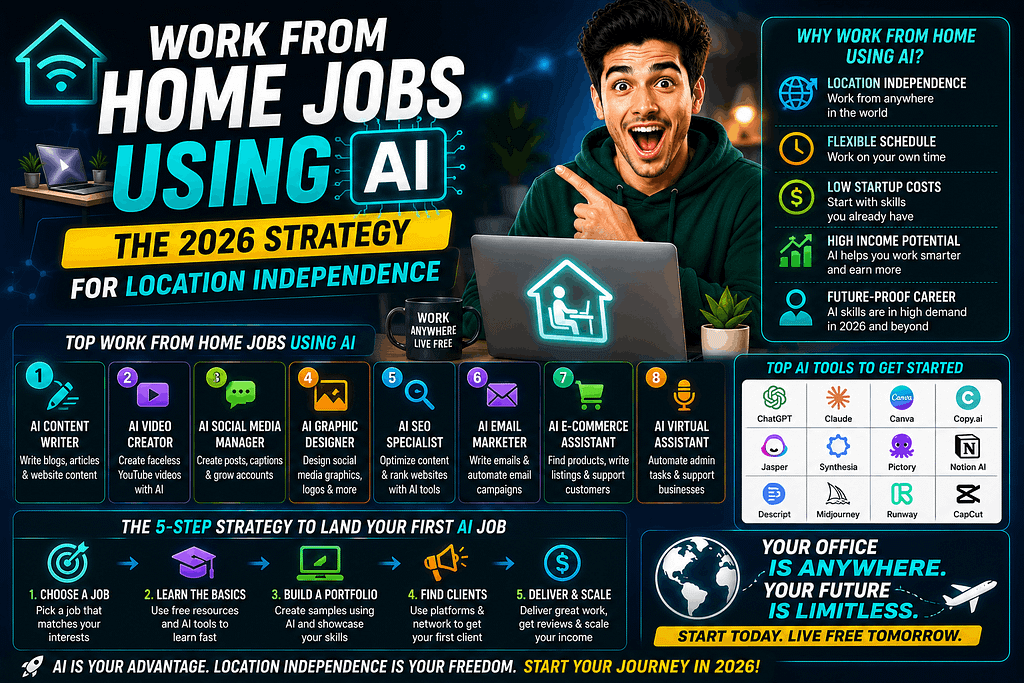
But as we navigate through 2026, a massive parallel economy has emerged. The smartest remote professionals have stopped fighting for traditional corporate desk jobs. Instead, they are stepping into high-yield, decentralized roles as AI Orchestrators. You don’t need a PhD in machine learning or an elite computer science degree to land these roles. In the modern remote landscape, the most valuable skill is no longer coding the software—it’s knowing how to direct it to produce high-value business outcomes.
Whether you are a professional in Austin looking to hedge against corporate layoffs, a creative mind building a portfolio on Earnify05, or simply someone wanting to reclaim their time, this 1,000-word blueprint breaks down the most profitable work from home jobs using AI in the US market today.
1. The Shifting Landscape: Moving from Task to Orchestration
The single biggest mistake beginners make when looking for work from home jobs using AI is searching for platforms that pay them $10 an hour to label images or rate chatbot responses. While those data-annotation micro-tasks exist, they are linear, exhausting, and rapidly being automated by the models themselves.
To build true financial autonomy, you must shift your perspective from a “task worker” to a Systemic Architect. Small and medium-sized businesses across the United States are currently drowning in technical debt. They know they need to implement artificial intelligence to stay competitive, reduce overhead, and scale their content, but they are too busy running their day-to-day operations to learn the infrastructure.
Your remote income comes from bridging that gap—using advanced tools to deliver polished, professional results that corporate clients are willing to pay a premium for.
2. Role #1: The AI Short-Form Content Alchemist
In 2026, attention is the most expensive commodity in the US economy. Every brand—from a boutique dental clinic in Charlotte to high-level venture capitalists in Silicon Valley—needs to maintain a hyper-active presence on TikTok, Reels, and YouTube Shorts. However, almost none of these business owners have the time or patience to sit inside complex video editing software.
-
The Remote Role: Short-Form Video Producer & Engagement Manager.
-
The System: You pull long-form webinars, podcasts, or zoom interviews from your clients and run them through OpusClip Pro or InVideo AI. The neural network automatically scans the footage, identifies the top 5 high-retention “hooks,” crops the frame to a vertical 9:16 mobile layout, and overlays dynamic, branded captions.
-
The Payout: Instead of charging hourly, you sell monthly “Social Retainer Packs.” Charging three local businesses a modest $400 a month to manage their vertical content pipeline lands you a predictable, recurring income stream for just a few hours of automated rendering a week.
3. Role #2: The Speech-to-Speech Vocal Engineer
The US corporate training, real estate, and e-learning markets are experiencing an unprecedented boom. Companies need hundreds of hours of clean, professional audio narration for onboarding modules, property tours, and digital audiobooks. Traditionally, this required hiring expensive voice actors and booking out specialized sound studios.
-
The Remote Role: Conversational Audio Architect & Podcast Producer.
-
The System: You leverage ElevenLabs’ Speech-to-Speech technology. Instead of typing text into a generator (which often sounds robotic and rigid), you record yourself reading the script into your phone. This preserves natural human breathing patterns, conversational emphasis, and organic pauses. You then use the AI to “mask” your voice with a high-end, studio-grade vocal avatar.
-
The Final Polish: Run that file through Adobe Podcast AI (Enhance) to instantly strip out room echo and background hum. You deliver a flawless, broadcast-quality audio asset from your kitchen table.
4. Role #3: SGE Search Restoration Consultant
With the full implementation of Google’s Search Generative Experience (SGE)—where search engine results pages are dominated by direct AI Overviews—thousands of small US businesses have seen their organic website traffic collapse. They are terrified of becoming invisible to local customers.
-
The Remote Role: Generative Engine Optimization (GEO) Strategist.
-
The System: You use Perplexity AI to run live-web “Gap Analysis” reports on local business niches (like plumbing companies or boutique law firms). You identify why the AI crawlers are failing to cite your client’s website in the “Answer Boxes,” then use SurferSEO or Claude 4 to restructure their text content into clear, entity-driven Q&A blocks that search models prefer.
-
The Payout: This is a high-ticket consulting role. A single comprehensive “SGE Restoration Audit” can easily sell for $500 to a business owner desperate to regain their market visibility.
5. Bypassing the Quality Filters: The “Human Signature”
The internet is currently flooded with low-effort machine output. If you try to fulfill these work from home jobs using AI by simply copying and pasting raw, unedited bot data, your clients will fire you, and your digital assets on platforms like Earnify05 will be flagged as spam. To keep your remote business highly profitable, you must apply the 10% Human Layer to every single deliverable:
-
Subjective Vetting: AI models frequently hallucinate facts, dates, and local US regulations. Your value lies in being the ultimate quality editor—verifying every statistic before it goes out.
-
Cadence Variety (Burstiness): Automated text generators love uniform, monotonous sentence lengths. Break the pattern manually. Use short, sharp realizations. Then, cascade into a longer, deeply descriptive thought. Rhythmic variety is a primary signal of authentic human writing to modern search crawlers.
-
Regional Touchstones: Embed specific, localized context into your work. Referencing a chaotic Monday morning commute on I-40 in North Carolina, or comparing a business bottleneck to a humid summer afternoon in Austin, adds an authentic, lived-in fingerprint that a machine cannot simulate.
Are you going to launch your remote AI career around Short-Form Video Production, Studio Audio Architecture, or Search Generative Optimization? Let’s map out your “Day 1” outreach strategy down in the comments below!