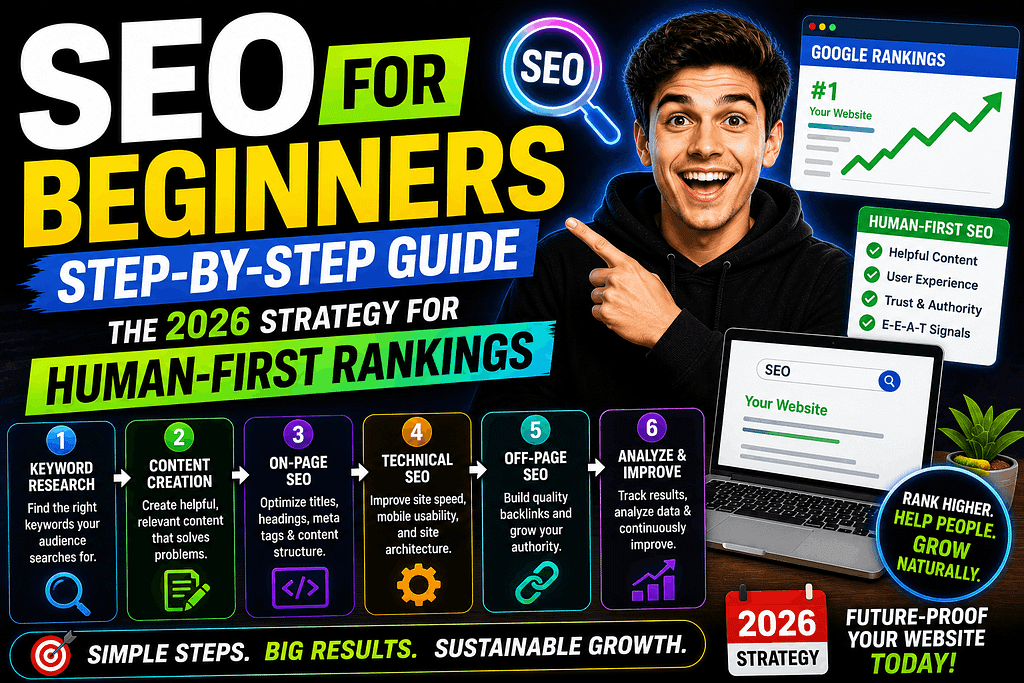
Let’s be brutally honest for a moment: the old SEO playbook is officially dead. If you’re sitting in a home office in Raleigh or a coffee shop in Austin trying to rank a website using tactics from a few years ago, you are essentially bringing a paper map to a GPS fight. As we move through 2026, the digital landscape hasn’t just changed—it has been completely reinvented.
We are now firmly in the era of Search Generative Experience (SGE) and AI-driven “Answer Engines.” Google is no longer just a simple index of blue links; it’s an advanced system that synthesizes context to give users direct answers. To win in this new environment, you don’t need to be a elite programmer or a data scientist. You need to be an Architect of Authority.
If you have a fresh website, a new blog, or a local business, this SEO for beginners step-by-step guide will give you a clear, no-nonsense roadmap to capturing massive US traffic. No gatekeeping, no “bot-speak”—just a direct path to the first page.
1. The 2026 Reality: Why “Slop” is a Search Death Sentence
The single biggest mistake beginners make is thinking optimization is about tricks or high-volume shortcuts. If you simply click “generate” on a generic prompt tool, copy that hollow text, and paste it into WordPress, you are creating what the industry calls “AI slop.” Search engines are now incredibly efficient at identifying and deprioritizing low-value, automated filler content.
To rank, your website must possess E-E-A-T: Experience, Expertise, Authoritativeness, and Trustworthiness. US-based readers from San Francisco to Charlotte are looking for a “Human-in-the-Loop.” They want to know that a real person with real-world experience has vetted the information. Machines provide raw data, but you provide the soul.
2. Step 1: Uncover High-Intent Search Queries
In 2026, keywords are just the skeleton; User Intent and Entities are the muscle. You shouldn’t be asking, “What word should I stuff into this paragraph?” horizontal tracking has shifted to, “What specific problem is my reader trying to solve?”
The “Answer Engine” Research Method
Instead of relying solely on expensive, outdated keyword software, use a live-web tool like Perplexity AI or Google’s native auto-complete to spot gaps.
-
Type a foundational phrase related to your niche (e.g., “starting a bakery”).
-
Look for conversational, long-tail questions that users are actively asking (e.g., “is starting an organic bakery profitable in NC”).
-
Map these questions out. Each distinct user problem forms the foundation for a single web page or article.
3. Step 2: Architect Content with the “10% Human Signature”
Once you know what topic to cover, you need to structure your page. To ensure your content is 100% human-centric, highly scannable, and completely clear of robotic clichés, apply the 10% Human Rule during your editing process.
A. Inject Subjective Anecdotes
Algorithms cannot have a “bad day,” a “lucky break,” or a business failure. They cannot tell you what it actually felt like to land a first client.
-
The Fix: Insert personal stories early on. For example: “When I launched my first digital project in Raleigh, I spent three months chasing dead-end keywords. Here is the exact moment I realized my mistake…”
B. Break the Sentence Pacing (Burstiness)
Automated text writing software loves “average” sentence lengths. To sound human, you must break the rhythm. Use short, punchy realizations.
-
The Style: “The strategy worked. But not for the reason I expected.” Follow that with a longer, descriptive sentence. Rhythmic variety is a massive structural signal of authentic human authorship.
C. Use Local and Cultural Geometry
Mentioning specific cultural touchstones or regional geography (like the brutal summer humidity in North Carolina or the coffee scene in Austin) signals to both the reader and the search indexers that a writer with genuine local context crafted the piece.
4. Step 3: On-Page Optimization Fundamentals
On-page optimization is simply formatting your content so search systems can read it efficiently. Think of it as labeling boxes clearly before a move.
-
Title Tag: Keep it under 60 characters. Place your primary focus keyword near the very beginning.
-
Headers (H2 & H3 tags): Break your content down every 200–300 words using logical subheadings. Treat your headers like a table of contents.
-
The URL Slug: Keep it short, clean, and keyword-focused. (e.g.,
/seo-beginners-step-by-step-guide). Avoid random strings of numbers or dates. -
Internal Linking: link your new article to 2 or 3 other relevant posts on your own site. This creates a “Topic Cluster,” signaling to search engines that you are building comprehensive authority on a macro-subject.
5. Step 4: Master Core Technical Uptime
You can have the most beautiful, human-written content in the world, but if your website is a technical nightmare, your traffic curve will remain flat.
-
Site Velocity: In the US, mobile users expect a page to load in under 2 seconds. Use lightweight themes, optimize your images, and pick a fast, reputable web host.
-
Mobile Responsiveness: Over 60% of search traffic originates from phones. Preview your site on a mobile device before every launch to ensure no text overlaps or layout breaks occur.
-
Secure Your Site (HTTPS): Ensure your site has an active SSL certificate. A “Not Secure” warning in a browser window kills user trust instantly.
6. Step 5: Drive Signals Through Strategic Distribution
In the 2026 ecosystem, you cannot simply “publish and pray.” You need to actively drive human traffic signals back to your URL to signal search engines that your page is buzzing with activity.
-
The Vertical Video Engine: Take the core takeaways from your article and use tools like OpusClip Pro to turn them into 60-second shorts or Reels. Link back to your full guide in your social bio.
-
Pinterest SEO: Pinterest is a visual search engine, not a social feed. Create a vertical graphic, optimize the description with your long-tail keywords, and pin it to a matching board to channel high-intent traffic to your new site.
Are you going to build your first authority cluster around Local Business, Tech Tutorials, or personal finance? Let’s map out your “Day 1” structural outline right below in the comments!