
Starting a blog is easy. Getting people to actually find it is the difficult part.
You can spend hours writing a detailed article, publish it, and still receive very little traffic if you’re targeting the wrong search terms. That’s why keyword research remains one of the most important parts of building a blog.
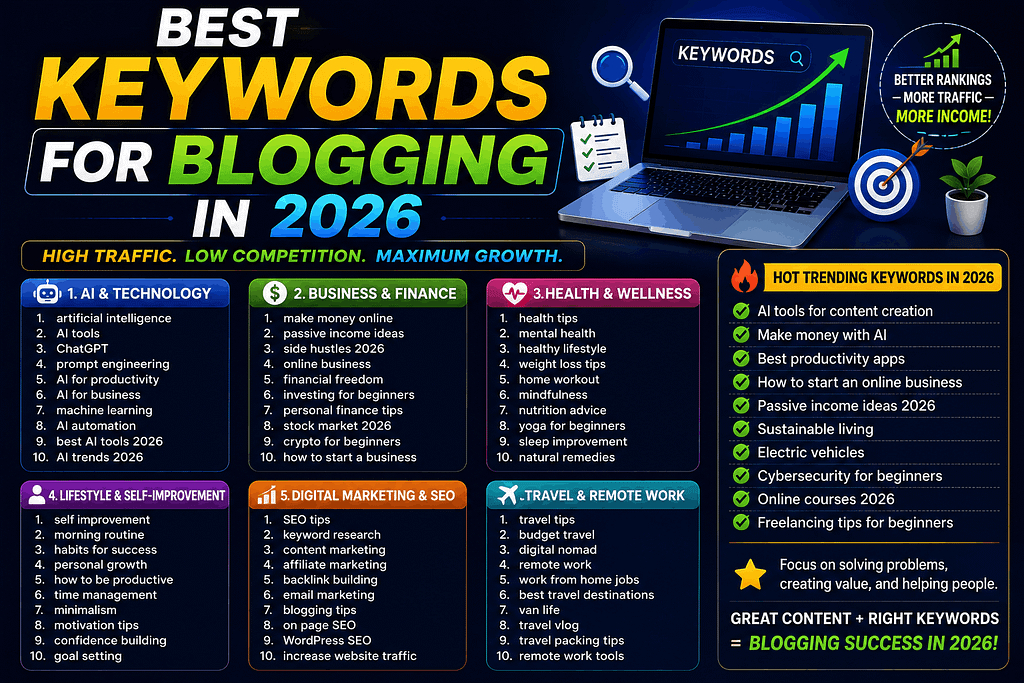
The Best Keywords for Blogging in 2026 aren’t necessarily the keywords with the highest search volume. For newer websites, the better opportunity is often finding specific phrases that match what readers are actually searching for and that your website has a realistic chance of ranking for.
For bloggers targeting the U.S. market, this becomes even more important. Search behavior changes, competition varies by niche, and people increasingly use specific questions when looking for information online.
At Earnify05, we believe good keyword research starts with understanding people—not simply looking at numbers inside an SEO tool.
What Makes a Keyword Good for Blogging?
Before creating a list of keywords, it’s important to understand what makes one worth targeting.
A useful keyword usually has several characteristics:
- It matches your niche
- People actually search for it
- The search intent is clear
- You can create genuinely useful content around it
- Competition is realistic for your website
- It has potential business value
For example, “money” is extremely broad.
Someone searching for “how to save $500 a month on groceries” has a much clearer problem.
The second phrase may have fewer searches, but the visitor’s intent is much easier to understand.
1. Long-Tail Keywords
Long-tail keywords are specific search phrases containing several words.
Examples include:
- How to start a side hustle with no experience
- Best budgeting apps for young professionals
- How to make money online after work
- Best AI tools for small business owners
- How to create a freelance portfolio
These searches can be valuable because they reveal a specific need.
For new blogs, long-tail keywords can also provide a more realistic starting point than extremely broad terms.
2. Question-Based Keywords
People frequently search Google using questions.
Examples include:
- How can I make extra money from home?
- What is the best budgeting method?
- How does AI help small businesses?
- How do I start freelancing?
- What are the best side hustles for beginners?
Question keywords are excellent for blog content because they naturally provide an article structure.
You can answer the question directly, explain the reasoning, provide examples, and finish with practical steps.
3. “Best” Keywords
Searchers often use the word “best” when they’re comparing options.
Examples:
- Best AI tools for freelancers
- Best budgeting apps
- Best side hustles for professionals
- Best productivity tools
- Best freelance websites
- Best business ideas for beginners
These keywords can have strong commercial potential because the person is often researching a decision.
If you use affiliate marketing, comparison articles can also become part of your monetization strategy.
However, recommendations should be based on genuine research rather than simply promoting products that pay commissions.
4. “How to” Keywords
How-to searches are especially useful for educational blogs.
Examples include:
- How to start a blog
- How to build an emergency fund
- How to make money with AI
- How to start freelancing
- How to grow Pinterest traffic
- How to create a digital product
These keywords attract readers who are looking for instructions.
A strong how-to article should actually walk the reader through the process rather than providing vague advice.
5. Low-Competition Keywords
Many new bloggers make the mistake of targeting keywords dominated by major websites.
Instead, look for smaller opportunities.
For example:
Very broad:
“Personal finance”
More specific:
“Personal finance tips for college graduates”
Even more specific:
“How to create a budget after graduating college”
The more specific keyword may have less search volume, but it can give a smaller website a better opportunity to establish relevance.
6. AI and Productivity Keywords
AI continues to create new blogging opportunities.
For a website like Earnify05, potential keyword themes include:
- AI productivity tools
- AI tools for professionals
- AI tools for freelancers
- AI business ideas
- AI side hustles
- How to use AI at work
- AI automation for small businesses
- Best AI tools for productivity
Instead of chasing every new AI tool, focus on practical questions people have about using AI.
Searchers are often more interested in what a tool can help them accomplish than in the technology itself.
7. Side Hustle Keywords
The side-hustle category can provide plenty of content ideas for U.S. audiences.
Potential topics include:
- Best side hustles for beginners
- Side hustles from home
- Weekend side hustles
- Online side hustles
- Side hustles using AI
- Freelance side hustles
- Side hustles for professionals
- Side hustles with no upfront cost
When writing about income opportunities, avoid promising guaranteed earnings.
Readers appreciate realistic explanations of the time, skills, and costs involved.
8. Personal Finance Keywords
Personal finance is another broad category that can be broken into specific topics.
Examples include:
- How to create a monthly budget
- How to save money on groceries
- Emergency fund for beginners
- How to pay off credit card debt
- Budgeting tips for young professionals
- How to reduce monthly expenses
- How to save money on a low income
Finance content requires extra care because readers may make important financial decisions based on what they read.
Use accurate information, explain limitations, and avoid presenting general information as personalized financial advice.
9. Comparison Keywords
Comparison searches can attract people who are close to making a decision.
Examples:
- X vs. Y
- Best budgeting app vs. spreadsheet
- Freelancing vs. traditional employment
- AI writing tools compared
- Different ways to make money online
Comparison articles should be balanced.
Explain the advantages, disadvantages, pricing considerations, and ideal use cases instead of declaring one option “best” without evidence.
10. Location-Specific Keywords
If you’re targeting the U.S. market, location can make keywords more specific.
Examples might include:
- Best side hustles in Texas
- Freelance opportunities in California
- Small business ideas in Florida
- Remote jobs for professionals in New York
- Budgeting tips for families in the U.S.
Local keywords can be particularly useful if your content or services are location-dependent.
How to Find the Best Keywords for Your Blog
Finding the Best Keywords for Blogging in 2026 doesn’t require guessing.
Start with a topic you understand.
Then:
Step 1: Brainstorm Topics
Write down questions your target audience might ask.
Step 2: Check Search Results
Search the phrase and examine what currently ranks.
Ask yourself:
Can I create something genuinely better or more useful?
Step 3: Look for Related Searches
Search engines often provide related queries that reveal additional content ideas.
Step 4: Use Keyword Research Tools
SEO platforms can provide information such as:
- Search volume
- Keyword difficulty
- Related keywords
- Search trends
- Competitor rankings
Treat these numbers as estimates rather than absolute facts.
Step 5: Analyze Search Intent
Determine whether the person wants:
- Information
- Instructions
- A comparison
- A product
- A service
- A specific website
Your article should match that intent.
Don’t Target Keywords Just Because They Have High Volume
High search volume can be tempting.
Imagine you find a keyword with 100,000 monthly searches.
It sounds incredible.
But if the first page is dominated by enormous websites with thousands of backlinks and years of authority, ranking may be extremely difficult for a new blog.
A keyword with 500 searches and realistic competition could potentially deliver much more value.
The goal isn’t to find the biggest keyword.
The goal is to find the right keyword.
Build Keyword Clusters
Instead of creating unrelated articles, organize your keywords into groups.
For example:
Main Topic: AI Productivity
Supporting keywords:
- Best AI productivity tools
- AI tools for professionals
- How to automate repetitive tasks with AI
- AI tools for remote workers
- AI productivity tips
- AI meeting assistants
You can create separate articles and link them together.
This creates a stronger content structure and gives readers multiple resources to explore.
Common Keyword Research Mistakes
Avoid these mistakes when building your 2026 content strategy:
Keyword Stuffing
Don’t repeat your focus keyword unnaturally.
Ignoring Search Intent
A perfectly optimized article can still disappoint readers if it doesn’t answer their question.
Copying Competitors
Study competing pages for ideas, but create your own original structure and insights.
Chasing Trends Only
Trending keywords can generate short-term traffic but may not create a sustainable audience.
Forgetting Existing Content
Your old articles may contain opportunities for new internal links, updated information, and additional related keywords.
Frequently Asked Questions
What are the best keywords for blogging in 2026?
The best keywords are relevant, specific, useful, and realistic for your website to target. Long-tail, question-based, comparison, and problem-solving keywords can be strong starting points.
How many keywords should one blog post target?
Focus on one primary keyword and naturally cover related terms and subtopics. Avoid forcing dozens of unrelated keywords into one article.
Are low-volume keywords worth targeting?
Yes. A low-volume keyword can still attract valuable visitors if the search intent closely matches your content and audience.
Should beginners target high-volume keywords?
Usually, it’s better to mix realistic long-tail opportunities with broader topics that you can build toward as your website grows.
Can AI help with keyword research?
AI can help brainstorm topics, organize keyword ideas, identify related questions, and create content plans. However, keyword data and search results should still be verified using reliable SEO tools and actual search results.
Conclusion
Finding the Best Keywords for Blogging in 2026 isn’t about discovering a secret list of magical phrases.
It’s about understanding your audience.
Start with the questions your readers are asking. Look for specific problems, long-tail searches, comparisons, how-to topics, and keywords that match your site’s expertise.
Then build useful content around those topics.
For Earnify05, areas such as personal finance, side hustles, AI productivity, freelancing, and online business provide plenty of opportunities to build focused keyword clusters for a U.S. audience.
Don’t chase every keyword you discover.
Choose the ones that make sense for your readers, create genuinely useful articles, connect related content with internal links, and improve your strategy as you learn from your traffic.
The right keyword isn’t simply the one with the highest search volume.
It’s the one that connects what people are searching for with what your website can genuinely help them accomplish.