
Let’s face the reality of the modern digital landscape: trying to rank a new website on the first page of search results in the United States often feels like trying to win a rigged carnival game. The algorithm updates are relentless, AI-generated overviews are pushing traditional links further down the screen, and massive media conglomerates seem to monopolize every major keyword. It is incredibly frustrating to pour your energy into a massive, 2,000-word article only to watch it get buried on page six, where no one will ever read it.
However, breaking through this digital noise does not require a massive corporate marketing budget or a team of offshore link builders. It requires a fundamental shift in how you structure your data. Search engines are no longer matching simple keywords; they are evaluating user intent, semantic authority, and technical friction.
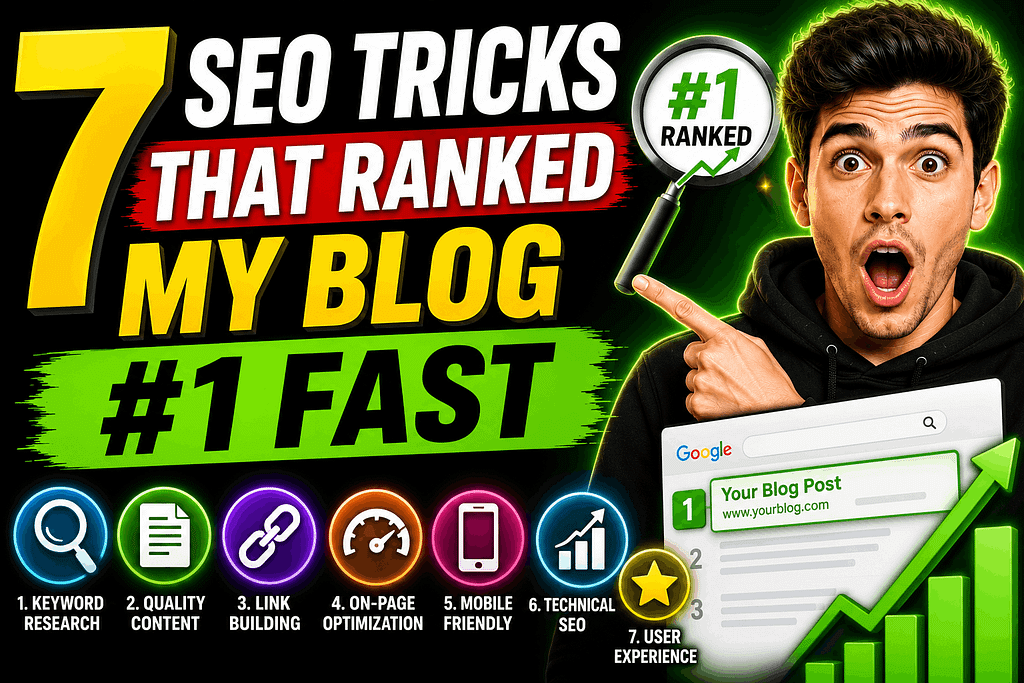
If you want to stop publishing into the void and start capturing highly profitable, high-intent traffic, you need a surgical approach. This comprehensive guide breaks down the exact framework and the 7 SEO Tricks That Ranked My Blog #1 Fast, allowing you to bypass the massive publications and secure top-tier organic visibility.
1. Target “Zero-Volume” Long-Tail Keywords
The biggest trap new bloggers fall into is relying strictly on traditional keyword research tools. These tools rely on historical data, meaning they are usually six to twelve months behind actual human behavior. If a tool says a keyword has 10,000 searches a month, you are already too late—massive websites have already monopolized it.
Instead, go directly to the search bar and utilize predictive text. Type in your niche and look at the highly specific, conversational questions that pop up. Often, keyword tools will claim these phrases have “zero search volume,” but they are actually emerging trends being actively searched by real people in the US. By writing highly targeted articles answering these specific, hyper-niche questions, you face zero competition and can rank in the top spot within days, building a foundation of compounding traffic.
2. Optimize for the “Answer Target” (Position Zero)
Modern search engines want to answer the user’s question directly on the results page. If a crawler has to dig through four paragraphs of your personal backstory just to find the definition of a term, it will completely ignore your article.
To capture the coveted top snippet (Position Zero), you must utilize the “Answer Target” format. Immediately underneath your primary subheadings, place a bold, standalone paragraph of roughly 40 to 60 words that directly answers the specific query. Give the search engine the punchline immediately. Once you provide the clinical, factual answer, you can spend the rest of the section diving into the nuanced details. This specific formatting hack drastically increases your chances of being featured at the very top of the page.
3. Build the Internal Link “Silo” Effect
Most digital creators publish a post, share it on social media, and completely forget to link it back to their older content. This is a massive mistake. Internal linking is how authority (or “link juice”) flows through your digital real estate.
If you are building an ambitious project or a specialized digital hub like Earnify05, you cannot treat your articles as isolated islands. You must cluster them. Write one massive “Pillar Page” covering a broad topic, and then publish five to ten smaller “Cluster Pages” that cover highly specific sub-topics. Link all of those smaller pages back to the main pillar. This interconnected web proves to the algorithmic crawlers that your domain possesses deep, comprehensive topical authority, instantly lifting the rank of every page in the cluster.
4. Eliminate “Zombie Pages” to Recover Crawl Budget
More content does not always mean more traffic. In fact, if your domain is weighed down by dozens of low-quality, outdated, or thin articles that receive zero impressions, search engines will view your entire site as a low-authority junk domain. This accumulated technical debt is a silent killer of organic traffic.
Run a comprehensive site audit and identify the “Zombie Pages”—articles that haven’t received a single click in the last six months. You have two choices: either aggressively update and merge them into one massive, ultimate guide, or delete them entirely and set up a clean 301 redirect to a relevant, high-performing page. Trimming the fat allows search bots to spend their crawl budget entirely on your premium assets.
5. Master Semantic Entity Optimization (LSI)
Ten years ago, SEO meant stuffing your target keyword into a post as many times as humanly possible. Today, doing that will get you heavily penalized. Search algorithms now utilize Natural Language Processing (NLP) to understand the context of a page.
Instead of repeating the same phrase, you must use Latent Semantic Indexing (LSI) keywords—terms that are conceptually related to your main topic. If you are writing about “credit card rewards,” the algorithm actively expects to see related entities like “annual percentage rate,” “frequent flyer miles,” “statement credit,” and “FICO score.” Covering the complete semantic vocabulary of a subject proves that your content is thoroughly researched and authoritative.
6. Crush Core Web Vitals (The Speed Mandate)
You can write the greatest article in the world, but if your site takes four seconds to load on a mobile connection, your US audience will bounce before reading a single word. Google tracks these user experience metrics relentlessly.
You must optimize your Core Web Vitals, specifically focusing on your Largest Contentful Paint (LCP). Stop uploading massive, raw image files to your server. Convert your entire media library to next-generation formats like WebP, implement lazy loading so images only render as the user scrolls, and use a premium caching plugin. Stripping away heavy code bloat and delivering a lightning-fast mobile experience is a non-negotiable requirement for ranking at the top.
7. Inject the “Subjective Friction” Layer
With the internet currently drowning in automated, AI-generated content, search engines are actively looking for the “human fingerprint.” An algorithm can compile statistics, but it cannot share a real-world failure, a localized anecdote, or a personal breakthrough.
To bypass spam filters and secure long-term rankings, you must infuse your writing with “Subjective Friction.” Do not just state facts; share the operational bottlenecks you faced. Mention how a specific strategy failed at first and the manual adjustments you had to make to fix it. Compare a digital marketing headache to sitting in heavy rush-hour traffic on a rainy interstate. This authentic, lived-in perspective—which a machine simply cannot simulate—is exactly what keeps readers engaged and signals high-quality trust to the search engines.