Let’s be brutally honest for a moment: the digital search landscape has fundamentally fractured. If you spend five minutes on marketing forums, you will be bombarded with outdated advice from 2018. Self-proclaimed gurus will tell you to stuff your articles with exact-match keywords, buy hundreds of spammy backlinks, and write endless 2,000-word fluff pieces just to appease a machine.
As we navigate through 2026, the American search market operates under an entirely different set of rules. Google’s Search Generative Experience (SGE)—alongside the rise of AI Overviews and answer engines—means that users are getting their questions answered directly on the search results page. The old method of tricking an algorithm is officially dead. Today, winning organic traffic requires a clean, highly structured, and human-first approach.
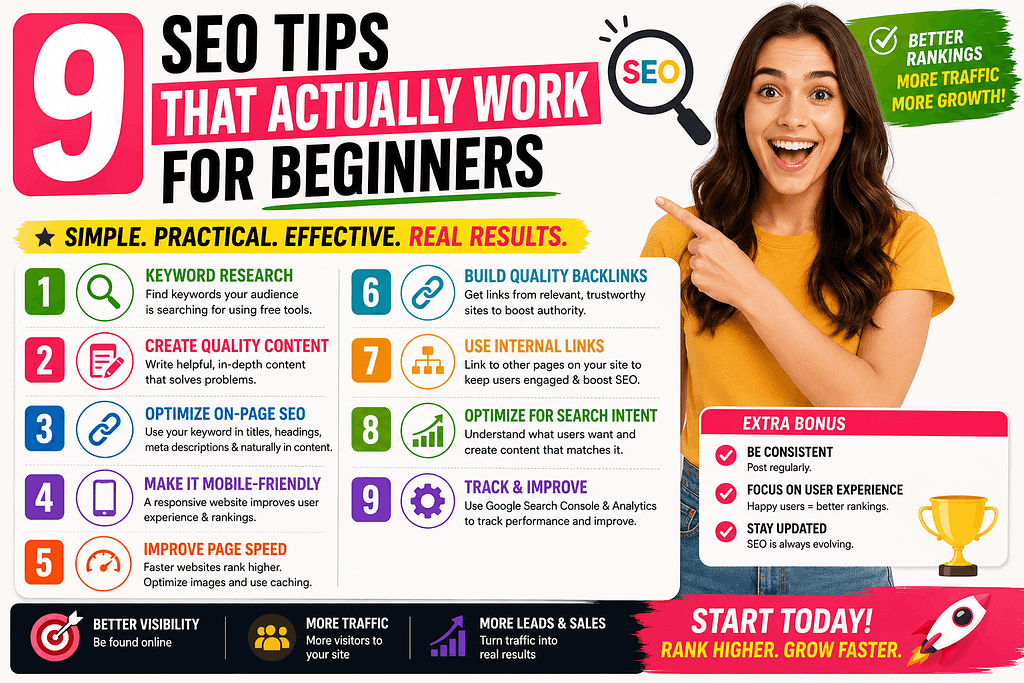
If you are launching a new digital asset, managing a tech portfolio, or trying to scale your readership, you do not need an advanced engineering degree to succeed. You just need to implement structural changes that signal absolute authority to modern crawlers. Here is your comprehensive guide detailing the 9 SEO tips that actually work for beginners to drive massive, high-intent traffic to your domain.
1. Implement the “40-Word Direct Answer” Block
Modern search engines operate as answer engines. If a crawler indexes your article and has to sift through four paragraphs of conversational introductory text just to find a simple definition, it will completely ignore your page when compiling its top-of-page AI Overview card.
The most effective fix for a new blog is to place a bold, plain-language, 40-to-60-word direct answer block immediately underneath your primary <h2> subheadings. Give the machine the punchline first. Frame the sentence so it acts as a standalone answer to a conversational query, which drastically increases your chances of being cited as a top authority source.
2. Shift to Semantic Entity Clusters
Search engines no longer rank isolated keywords; they rank topical authority. If you want to rank for “data analytics tools,” writing one massive article is not enough.
You must build a semantic cluster. This means writing one broad “Pillar Page” (e.g., The Ultimate Guide to Data Analytics), and then publishing five to ten smaller, hyper-specific “Cluster Pages” (e.g., How to Clean Datasets, The Best Tools for Predictive Modeling). Link all these smaller pages back to the main pillar. This interconnected web proves to the algorithm that your domain possesses deep, comprehensive knowledge on the subject.
3. Treat Internal Linking Like a Data Matrix
Most beginners publish an article and completely forget to link it to their older content. Internal linking is how “link juice” (authority) flows through your digital real estate.
When structuring the internal linking for the tech and AI articles on Earnify05, I approached the layout exactly like building a data science matrix. Just as you might use Apache Spark to cluster and process massive, interconnected datasets efficiently, you must cluster your topical pages. Every new article should strategically link back to three older, relevant articles, creating a closed-loop system that keeps users—and search crawlers—trapped in your ecosystem for longer periods.
4. Prune the “Zombie Pages”
One of the leading causes of modern visibility loss is accumulated technical debt. If your website has 20 different short, low-quality blog posts hovering around similar, outdated topics, search models view your domain as fragmented and weak.
Run a quick audit on your site. Look for pages that have received zero impressions and zero clicks over the last six months. You must either consolidate those thin articles by merging their data into one massive, high-value guide, or delete them entirely and set up a clean 301 redirect to your homepage. Cleaning up these zombie pages allows Googlebot to utilize its crawl budget efficiently, instantly lifting your remaining assets.
5. Crush Core Web Vitals (The Speed Mandate)
In the US market, mobile users expect a site to load in under two seconds. If your Largest Contentful Paint (LCP) lag is high because your pages are weighed down by massive, uncompressed graphics, your user dwell time will drop, and your rankings will crater.
Stop uploading raw JPEGs or PNGs to your site media library. Download a free batch image converter and shift your entire media ecosystem to WebP formats. Compress every graphic and implement native lazy loading so images only render as the user scrolls down the page.
6. The Page 2 Meta Overhaul
Getting an article to jump from the top of page two to the middle of page one is the single fastest way to double your organic traffic without writing a single new word.
Navigate to your search performance dashboard and filter for pages ranking between positions 11 and 15. Look for URLs that boast high impressions but a miserable click-through rate. Your titles and meta descriptions are failing to trigger human curiosity. Rewrite your title tag to place the target keyword near the front, and craft a meta description that highlights a distinct, emotional benefit to force a click.
7. Optimize for the “Query Fan-Out”
To capture modern traffic, your text must answer the precise follow-up questions that consumers ask after reading an initial answer. This is called the Query Fan-Out.
Do not rely solely on traditional keyword tools. Type your main topic into Google and look directly at the “People Also Ask” dropdown boxes. These are the exact conversational, long-tail questions that real humans are typing on their phones. Turn those exact questions into your <h3> subheadings to capture highly targeted, low-competition traffic.
8. Establish E-E-A-T Infrastructure
Because the open web is currently drowning in a sea of automated, copy-paste machine outputs, search crawlers are prioritizing verified entities. They want to know exactly who wrote the information (Experience, Expertise, Authoritativeness, Trustworthiness).
Build a rich, dedicated Author Bio box at the base of every informational article. Do not just use a generic nickname. List your real credentials, specific industry experience, and links to your active professional networks. Implement Author Schema markup in your site’s header to explicitly tell crawlers who you are.