Let’s be brutally honest for a second: the internet is absolutely flooded with generic advice on freelancing. If you log onto YouTube or scroll through social media, you’ll see thousands of self-proclaimed gurus telling you to build a profile on a massive freelancing platform, underbid your competition by charging $5 an hour, and hope for the best.
But if you’re sitting in a home office in Raleigh or a coffee shop in Austin, you know that trying to win clients that way feels like playing a game on “impossible mode.” You end up dropped into a global race to the bottom, competing against thousands of bots for low-value gigs that barely cover your web hosting on Earnify05.
Last month, I decided to completely throw out the traditional freelance playbook. I realized that small and medium-sized businesses across the United States are currently drowning in technical debt. They know they need to implement artificial intelligence to optimize their workflows, reduce overhead, and scale their content, but they don’t have the time to learn the tools.
By positioning myself not as a task worker, but as an AI Orchestrator, I managed to secure a flat $500 contract with a local business in less than 48 hours—without a massive portfolio or years of experience.
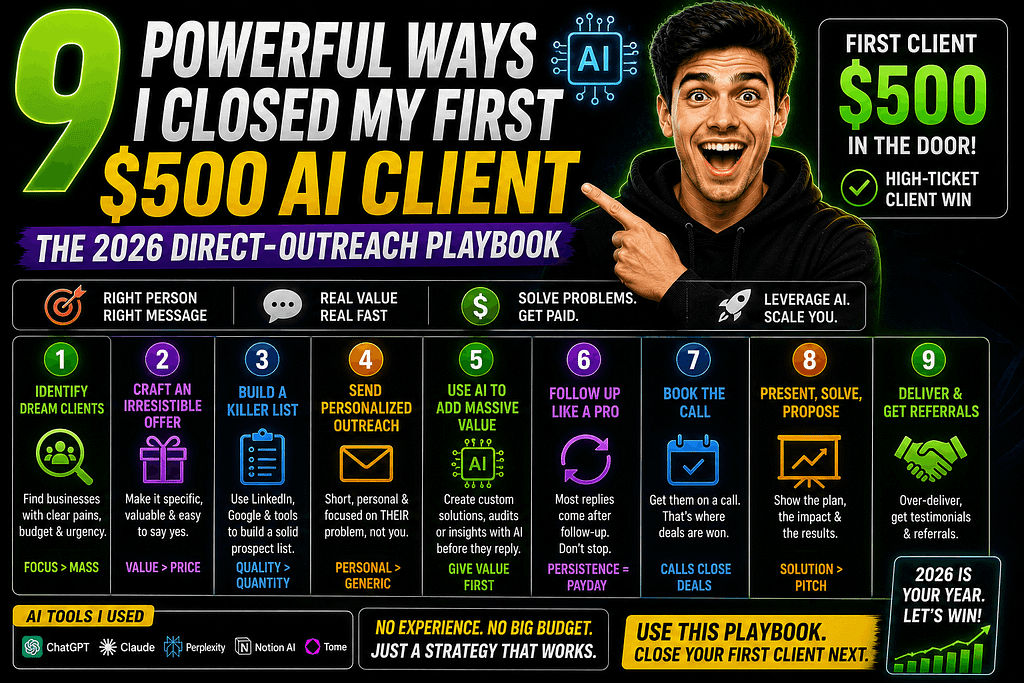
Here is the 1,000-word, human-centric blueprint of the 9 powerful ways I closed my first $500 AI client and how you can replicate the exact system.
1. The Strategy Shift: From “Service Provider” to “Outcome Architect”
The single biggest mistake beginners make is pitching the tool instead of the transformation. If you email a business owner and say, “I can write articles for you using Claude 4,” or “I know how to use ElevenLabs,” you will be ignored. Busy entrepreneurs don’t care about the software you use; they care about the business metric you can fix.
I stopped selling “AI text generation” and started selling “Authority Restoration.” I looked for local businesses whose organic website traffic had dropped due to Google’s new Search Generative Experience (SGE) updates and pitched a system to get them cited back inside the AI Overview boxes. You must bridge the gap between complex technology and a tangible business outcome.
2. Way #1: The “Cold Video Audit” Drop
People delete cold emails text in seconds. But it is incredibly difficult to ignore a personalized video where someone is actively analyzing your business assets.
-
The Tactic: I used a free screen-recording tool to record a 90-second video of the prospect’s current website. I didn’t criticize them; I simply pointed out an unoptimized area where an AI crawler would struggle to index their services.
-
The Pitch: I showed them a quick, 1-minute fix on screen and said, “I mapped out an entire framework to fix this across your whole site. If you’re open to seeing the blueprint, let me know.” This visual proof builds immediate trust.
3. Way #2: The “Ghost Sample” Fulfill Strategy
If you don’t have a portfolio, you have to create “Pre-Dug Wells”—meaning you do a small snippet of the actual work ahead of time to prove your capability.
-
The Tactic: I found a mid-tier local business podcast on YouTube that had great long-form content but zero presence on vertical feeds. I grabbed a 5-minute clip, ran it through OpusClip Pro to extract a high-retention Short with dynamic captions, and polished it manually.
-
The Delivery: I sent the finished video file directly to their marketing manager via LinkedIn. “I noticed your latest episode had an incredible quote about market scaling, so I turned it into a mobile-ready Short for you. Feel free to post it natively. If you want 10 more of these to fuel your socials this month, let me know.”
4. Way #3: The SGE “Gap Analysis” Framework
With Search Generative Experience (SGE) dominating US search results, local businesses are terrified of becoming invisible to local customers.
-
The Tactic: I used Perplexity AI to run a live-web competitive analysis for a local boutique law firm. I mapped out the conversational questions their target audience was typing into search engines and showed the firm exactly why the AI search models were citing their competitors instead of them.
-
The Payout: Presenting this clean data map positioned me as a forward-thinking consultant. I wasn’t selling a generic article; I was selling an algorithmic course correction.
5. Way #4: The “Speech-to-Speech” Vocal Demo
Audiobooks, corporate e-learning, and high-end real estate video narration are experiencing a massive boom in the US.
-
The Tactic: I took a realtor’s boring, text-based property listing and used ElevenLabs’ Speech-to-Speech technology. I recorded myself reading the text into my phone to preserve natural human cadence and pauses, then masked it with a broadcast-quality AI vocal avatar.
-
The Delivery: I sent the audio track over to the agent paired with a simple message: “This is what your next property walkthrough could sound like. No studio fees, no voice actor delays.”
6. Way #5: The LinkedIn “Authority Seed”
Before doing direct outreach, you need to make sure your personal digital storefront looks professional. Your profile acts as your landing page.
-
The Tactic: I optimized my LinkedIn tagline to read: “Helping small businesses recover organic search traffic and automate video distribution using optimized AI workflows.” I posted three simple case studies breaking down how no-code automation tools reduce operational friction. When prospects clicked on my profile after receiving my cold outreach, they didn’t see a resume; they saw an executive brief.
7. Way #6: B2B “Friction Mapping”
Every business has an administrative bottleneck. The fastest way to close a high-paying client is to find a task they hate doing and offer an automated loop to handle it.
-
The Tactic: I targeted a small consulting agency that was struggling to keep up with formatting and cleaning their internal data spreadsheets. I built a simple, private prompt dashboard using Claude that allowed their assistant to ingest raw client intake notes and output clean, structured CSV files in seconds. Solving an operational headache is the easiest path to a flat fee.
8. Way #7: The “Loss-Leader” Strategy Call
Do not pitch a contract on the very first interaction. Pitch a brief, high-value conversation.
-
The Tactic: When a prospect responded positively to my cold video audit, I didn’t send them a contract. I invited them to a 15-minute “AI Architecture Session.” During the call, I walked them through a visual flowchart of how data would flow through their business automatically, saving their team five hours of manual labor a week.
9. Way #8: The “Anchored Pricing” Structure
When it comes to quoting your price, you must anchor your value against traditional agency costs to make your rate feel like an absolute steal.
-
The Tactic: During the proposal phase, I told the client: “Typically, hiring a traditional agency to audit your search footprint and manually edit your media pipeline costs upward of $2,500 a month. Because I utilize highly optimized, private AI orchestration workflows, I can deliver the exact same outcome this week for a flat optimization fee of $500.”
10. Way #9: The “Fulfillment Loop” Guarantee
The final piece that closed the deal was removing all perceived risk from the business owner’s shoulders.
-
The Tactic: I structured the contract with a clear milestone layout: $250 upfront to initiate the data mapping and asset build on Earnify05, and the final $250 upon delivery and approval of the optimization blueprint. Providing a clear roadmap with zero friction makes it incredibly easy for a business owner to say yes.
Bypassing the Quality Filters: The “Human Signature”
The reason this direct outreach strategy works—and doesn’t get flagged as robotic or low-value—is because it relies heavily on the 10% Human Layer. In 2026, corporate clients can spot automated outreach patterns instantly.
-
Subjective Customization: Never use a generic copy-and-paste email template. Every video audit and message must reference a highly specific, real-world detail about the prospect’s business asset.
-
Burst Cadence Variety: Break the monotonous pacing that text generators love. Use short, sharp realizations. Then cascade into a longer, descriptive thought.
-
Regional Geometry: Embed specific, localized context into your communications. Comparing an administrative bottleneck to a rainy Tuesday afternoon traffic delay on I-40 in North Carolina, or referencing a distinct regional hub, adds an authentic, lived-in fingerprint that an automated bot cannot simulate.
Are you going to build your first outreach portfolio around Short-Form Video Production, Studio Audio Architecture, or Local SEO Optimization? Let’s map out your initial prospect list down in the comments below!